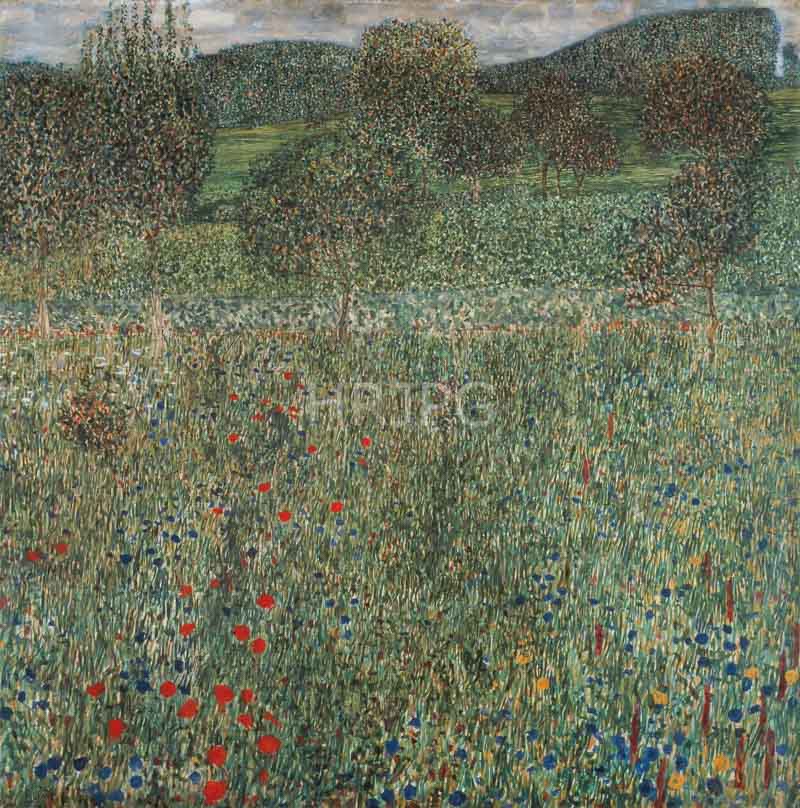
Artist: Gustav Klimt, Year: 1913. "Malcesine on Lake Garda" is a masterful late landscape painted during a rare summer trip away from his usual retreats at Lake Attersee. In 1913, Klimt traveled to the Italian shores of Lake Garda, where he was captivated by the unique light and the dense, vertical architecture of the village. This work represents his mature "International Style," where he began to move away from gold ornamentation to explore a more "painterly and architectural" approach to nature and urban forms. It is widely considered a modern decorative masterpiece, illustrating his ability to organize a chaotic landscape into a shimmering jewel-like pattern.
Technically, the composition is characterized by its "compressed perspective" and its extraordinary density of detail. Klimt utilizes a "high horizon line," pushing the lake and the distant hills to the very top edge of the canvas, which forces the viewer's eye to remain fixed on the "mosaic of rooftops" and foliage. The village of Malcesine is integrated into the natural environment so perfectly that the architectural elements appear as organic components of the pattern. He utilizes a palette dominated by vibrant, deep greens and warm terracotta tones, applied with a "mosaic-like" technique influenced by Pointillism and the geometric structures of the early Cubists. This approach creates a "flattened decorative surface" that emphasizes rhythm and texture over three-dimensional depth, transforming a topographic view of an Italian village into a timeless, highly stylized work of art. The use of a telescope allowed him to achieve this "telescopic" flattening of space, organizing the roofs and the greenery into a harmonious, rhythmic whole. This "all-over" composition forces the eye to wander through the textured richness of the paint, mirroring the immersive qualities of the natural world.
Historically, 1913 was a year of international consolidation for Klimt. His landscapes were highly sought after by the Viennese elite, who saw in them a refined, modern vision of beauty. The trip to Italy provided him with a new light and a different architectural rhythm, which he successfully synthesized with his own Secessionist aesthetic. The work reflects the "Fin-de-Siècle" search for order and tranquility amidst the growing social and political instability of pre-war Europe. It exemplifies the concept of the Gesamtkunstwerk, where every component of the scene contributes to a unified, modern aesthetic experience.
Art criticism has long lauded "Malcesine on Lake Garda" for its "extraordinary decorative intensity." Critics such as Frank Whitford have noted the "Cubist-adjacent flattening" of the work, describing it as a "tapestry of rooftops." The painting is praised for its "innovative synthesis" of Italian scenery and Viennese design, proving that Klimt’s brilliance was rooted in his ability to see the world as a shimmering, organized whole. Today, it remains a celebrated part of his repertoire, standing as a testament to his unrivaled ability to transform a village into a shimmering, eternal mosaic of summer color.