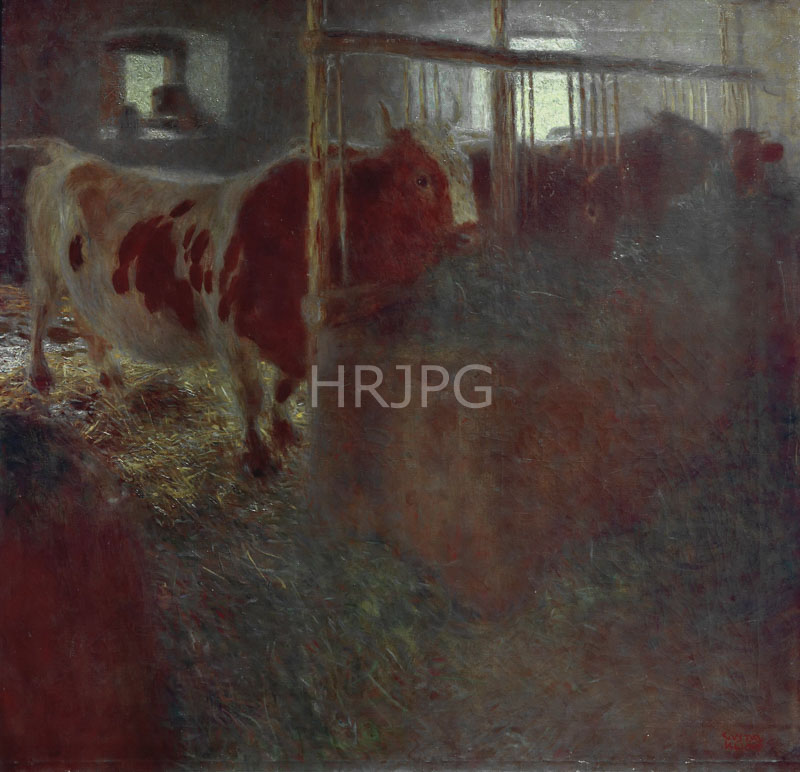
Artist: Gustav Klimt, Year: 1902. The lush landscape "Beech Forest" (Buchenwald) is a premier example of Klimt’s early innovative approach to nature, produced during his summer retreats to Lake Attersee. In 1902, Klimt was deeply involved in the Vienna Secession’s 14th exhibition, yet his landscapes provided a necessary psychological escape from the public controversies of his mural commissions. This work represents a significant move toward a more "Symbolist" and decorative vision of the natural world, where the forest is treated as a sacred, immersive space rather than a mere topographic record.
Technically, the composition is defined by its "radical verticality" and the use of the square format. Klimt fills the entire canvas with the dense, rhythmic pattern of tree trunks, effectively eliminating any sense of sky or distant horizon. This "all-over" composition—influenced by Japanese woodblock prints and Belgian Symbolism—creates a "flattened decorative surface" that forces the viewer's eye to wander through the vertical lines. He utilizes a mosaic-like application of color, particularly in the rendering of the forest floor, where thousands of tiny dabs of ochre, russet, and gold create a shimmering carpet of autumnal leaves. The trunks themselves are rendered with rhythmic brushstrokes that capture the texture of the bark and the play of filtered light without relying on traditional chiaroscuro. This technique transforms the natural scenery into a "shimmering mosaic of color," where the distinction between individual trees and the collective environment begins to dissolve. The lack of a traditional focal point creates a sense of "infinite space," inviting the viewer to participate in the spiritual quietude of the woods.
Historically, 1902 was a year of professional consolidation for Klimt, following the success of the "Beethoven Frieze." The focus on the forest interior reflects the "Fin-de-Siècle" obsession with nature as a "secular cathedral," a place of spiritual renewal and aesthetic contemplation. The work reflects the influence of "Mood Impressionism" (Stimmungsimpressionismus), combined with the rising interest in decorative abstraction. It marks the birth of his mature landscape style, which prioritized "texture and rhythm" over realistic perspective.
Art historians have consistently praised "Beech Forest" for its "extraordinary atmospheric intensity." Critics such as Frank Whitford have noted the "obsessive observation" and the "ornamental harmony" of the work, describing it as a landscape that has been "filtered through a poetic lens." The painting is praised for its ability to capture a sense of "timeless stillness," prefiguring the later move toward total abstraction. Today, it remains a cornerstone of major collections, standing as a testament to Klimt's unrivaled ability to see the sacred and decorative within the density of the natural world.