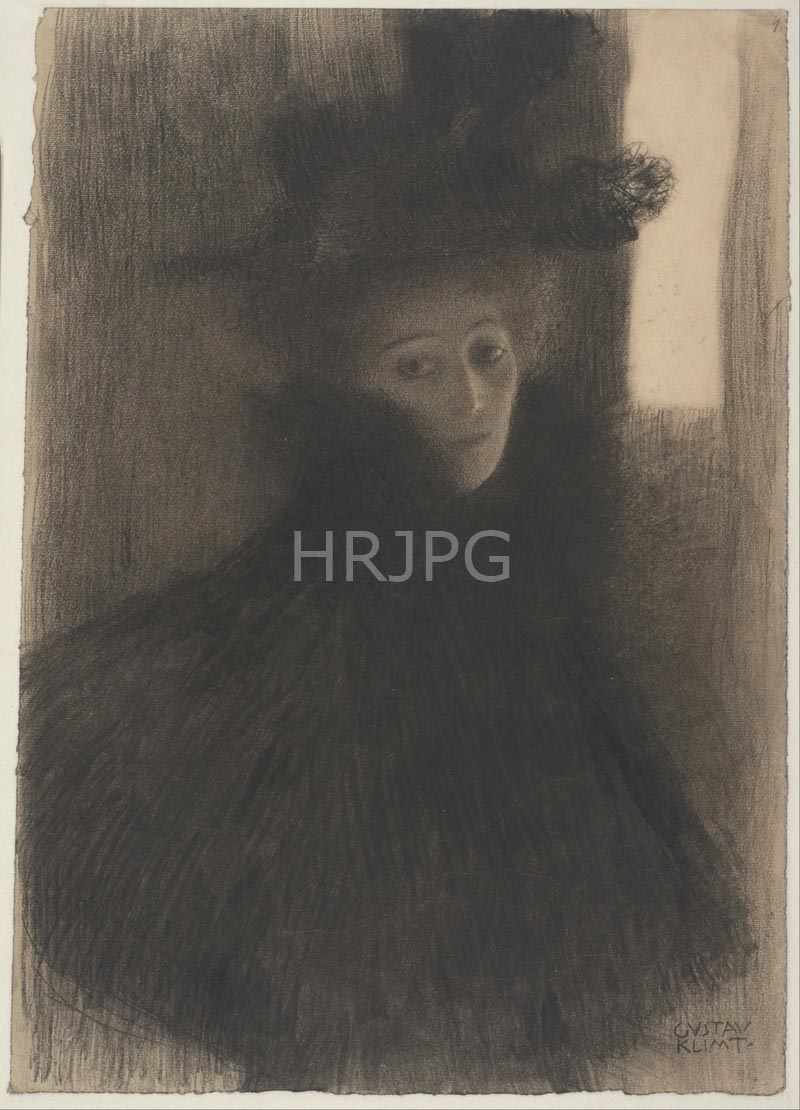
Artist: Gustav Klimt, Year: 1910. "The Black Feather Hat" (also known as "Dame mit Hut und Federboa") is an elegant and psychologically resonant portrait that represents a critical transitional moment in Klimt’s career. By 1910, the artist was beginning to move away from the dense gold leaf of his middle years toward a more "atmospheric and linear" style. This work captures the height of "Fin-de-Siècle" Viennese high fashion, focusing on a woman wearing an oversized black feather hat. It serves as a profound investigation into modern feminine style and character, reflecting the sophisticated and often melancholic aura of the city’s upper-middle-class elite during the early 20th century.
Technically, the composition is defined by its "bold silhouette" and the dramatic contrast between light and dark. Klimt utilizes a massive, dark "feather hat" to frame the subject's face, creating a heavy vertical anchor that dominates the upper half of the canvas. The subject’s pale skin and delicate features are modeled with soft transitions, providing a luminous focal point amidst the dark textures of the hat and the boa. The color palette is remarkably restrained, dominated by blacks, deep grays, and warm skin tones, which creates a sense of "aristocratic distance" and mystery. The brushwork is more gestural and "impressionistic" than his earlier polished murals, influenced by the works of Edouard Manet and the international Symbolists. This technique priorities the "aura" of the subject over topographic detail, using the massive hat as a decorative and architectural element that reflects the subject's social status and internal state. The use of a mottled, dark background further pushes the luminous face forward, creating a strong sense of three-dimensional presence within a flattened decorative frame.
Historically, 1910 was a year of international success for Klimt, marked by his exhibition at the Venice Biennale. The "oversized hat" was a hallmark of the "Modern Woman" in Vienna—a figure who was increasingly independent yet still confined by the rigid social expectations of the era. This work reflects the close relationship between Klimt and the fashion world of the Wiener Werkstätte, where clothing was seen as a primary medium for artistic expression. It captures the spirit of "Modern Vienna"—a city obsessed with the surface as a mirror of the soul and fashion as a form of "living art."
Art criticism has long praised "The Black Feather Hat" for its "sophisticated characterization" and its "technical purity." Critics such as Frank Whitford have noted the "psychological gravity" of the work, describing it as a "portrait of modern anxiety." The painting is celebrated today for its "tender realism" and its ability to convey a sense of monumental beauty through a focused, domestic subject. It remains a vital document for understanding Klimt's stylistic evolution, proving that his brilliance lay in his ability to capture the complex, intimate, and sacred landscape of the human spirit through the elegance of high fashion.