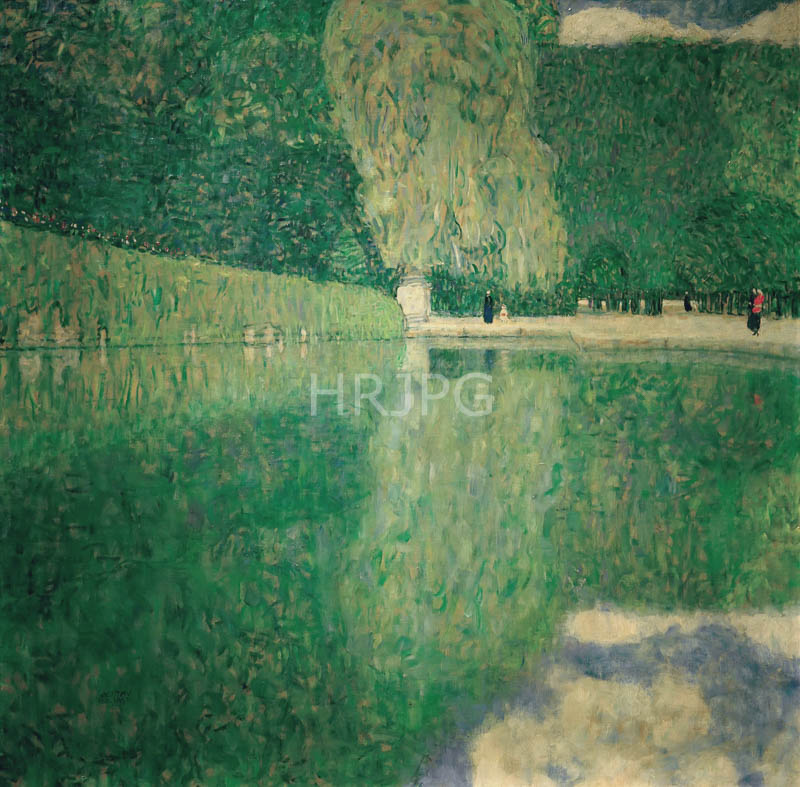
Artist: Gustav Klimt, Year: 1911. The lush oil landscape "Upper Austrian Farmhouse" was painted by Gustav Klimt in 1911. This work belongs to his mature landscape period, produced during his annual summer retreats to Lake Attersee. By 1911, Klimt had moved away from the intense gold-leaf ornamentation of his earlier career to explore a more "painterly" and atmospheric representation of the natural world. This painting captures the rhythmic beauty of the Austrian countryside, transforming a simple rustic farmhouse into a shimmering, decorative tapestry of color and light that reflects the artist's search for "total harmony" within nature.
Technically, the composition is characterized by its "flattened decorative surface" and the use of an "impressionist mosaic" style. Klimt utilizes a square format and a compressed perspective, which brings the farmhouse and the dense field of wildflowers into a single, shimmering plane. The architecture of the farmhouse is integrated into the surrounding greenery so perfectly that it appears as an organic component of the pattern. He utilizes a palette dominated by vibrant greens and earthy terracottas, applied with thousands of small, rhythmic brushstrokes that create a shimmering effect. This technique prioritizes "pattern and texture" over traditional spatial perspective and depth, transforming a topographic view of an Upper Austrian farm into a timeless, highly stylized work of art. The "all-over" composition forces the eye to wander through the textured richness of the paint, mirroring the immersive qualities of the natural world. This approach illustrates his mastery in seeing the architectural structure within organic forms, where every component of the scene—from a single petal to a stone wall—contributes to a unified, modern aesthetic whole.
Historically, 1911 was a year of international consolidation for Klimt, marked by his success at the International Art Exhibition in Rome. His landscapes were his most private works, created for his own satisfaction. The focus on the farmhouse reflects his close connection to the region and his interest in the "cultivated nature" of the countryside. This period in Vienna was marked by the "garden movement," which saw nature as a sanctuary of aesthetic renewal. The painting captures the spirit of "Modern Vienna," where the elite sought to find eternal beauty in the quietude of the rural landscape amidst the rapid changes of the modern city.
Art criticism has long celebrated "Upper Austrian Farmhouse" for its "extraordinary atmospheric intensity." Critics such as Frank Whitford have noted the "tapestry-like" quality of the work, describing it as a "masterpiece of modern rhythm." The painting is praised for its "innovative design," prefiguring the later move toward total abstraction. Today, it remains a cornerstone for understanding the evolution of his mature landscape style, standing as a testament to his unrivaled ability to see the extraordinary and sacred beauty within the density of the rural landscape.