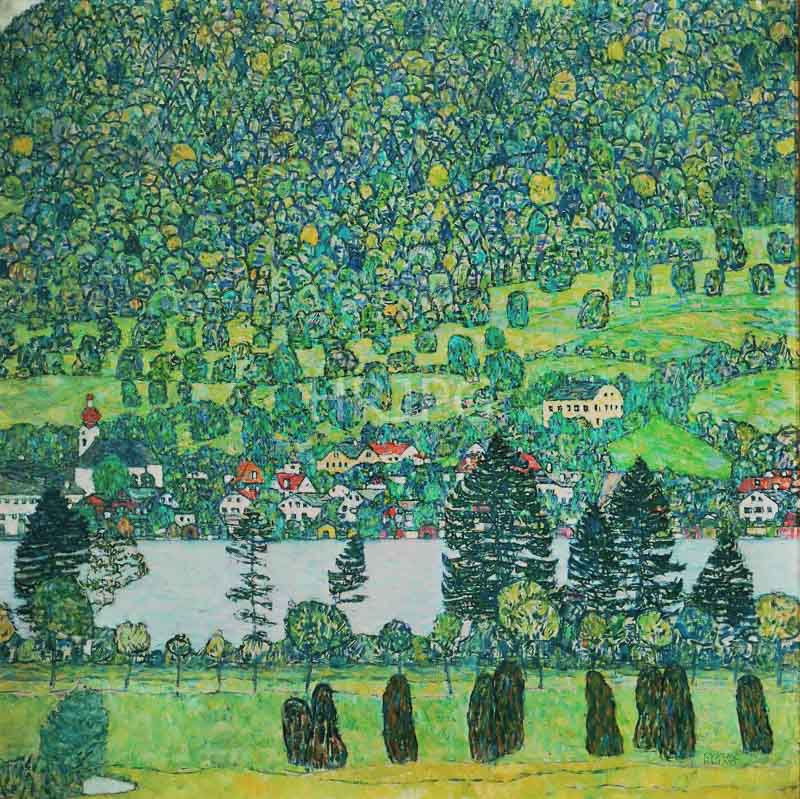
Artist: Gustav Klimt, Year: 1916. "Forest Slope in Unterach on the Attersee" is a masterful oil landscape painted during the final years of Klimt’s life. This work belongs to his mature "International Style," where the rigid gold surfaces of his middle years were replaced by a more painterly and expressive focus on color and texture. Amidst the gathering shadows of World War I, Klimt retreated into the "tranquil rhythms" of the Austrian countryside, and this painting serves as a profound celebration of nature’s density and atmospheric beauty. It is a work that transforms a topographic view into a shimmering tapestry of light.
Technically, the composition is characterized by its "radical verticality" and the use of the square format. Klimt fills the square canvas with an "immersive pattern" of greens and yellows, effectively eliminating any middle ground or traditional horizon. This approach creates a sense of "horror vacui," where every square inch of the surface is vibrating with life. He utilizes thousands of small, rhythmic brushstrokes influenced by Pointillism to create a "flattened decorative surface" that captures the play of light within the dense woods without relying on traditional perspective. The forest slope is treated as a single, monumental entity, where individual trees lose their botanical identity to become part of a larger, shimmering tapestry. The color palette is extraordinarily rich, featuring a symphony of emeralds and ochres that suggest the warmth of a summer afternoon. The lack of a clear focal point or human presence emphasizes the eternal, static beauty of nature, forcing the viewer to engage directly with the "vibration of the paint." This technique illustrates Klimt's search for a "decorative Symbolism," where nature is presented as a sacred and highly organized sanctuary.
Historically, 1916 was a year of profound personal and political transition for Klimt. His summer landscapes were his most private works, created for his own satisfaction. The focus on the "forest slope" reflects the "Fin-de-Siècle" obsession with the forest as a "secular cathedral," a place of spiritual renewal and aesthetic contemplation. The work reflects the influence of the "Scandinavians" and the "Symbolists" on the Secessionist aesthetic, particularly their focus on the poetic and spiritual qualities of the landscape. It captures the spirit of "Modern Vienna," where the elite sought to find eternal beauty in the quietude of the countryside amidst the rapid changes of the modern city.
Art historians have consistently praised "Forest Slope in Unterach" for its "extraordinary atmospheric intensity." Critics such as Frank Whitford have noted the "tapestry-like" quality of the work, describing it as a "masterpiece of modern design." The painting is praised for its "innovative synthesis" of Impressionist light and Secessionist design. Today, it remains one of the highlights of his late landscape repertoire, standing as a testament to Klimt's unrivaled ability to see the extraordinary and sacred beauty within the density of the natural world.