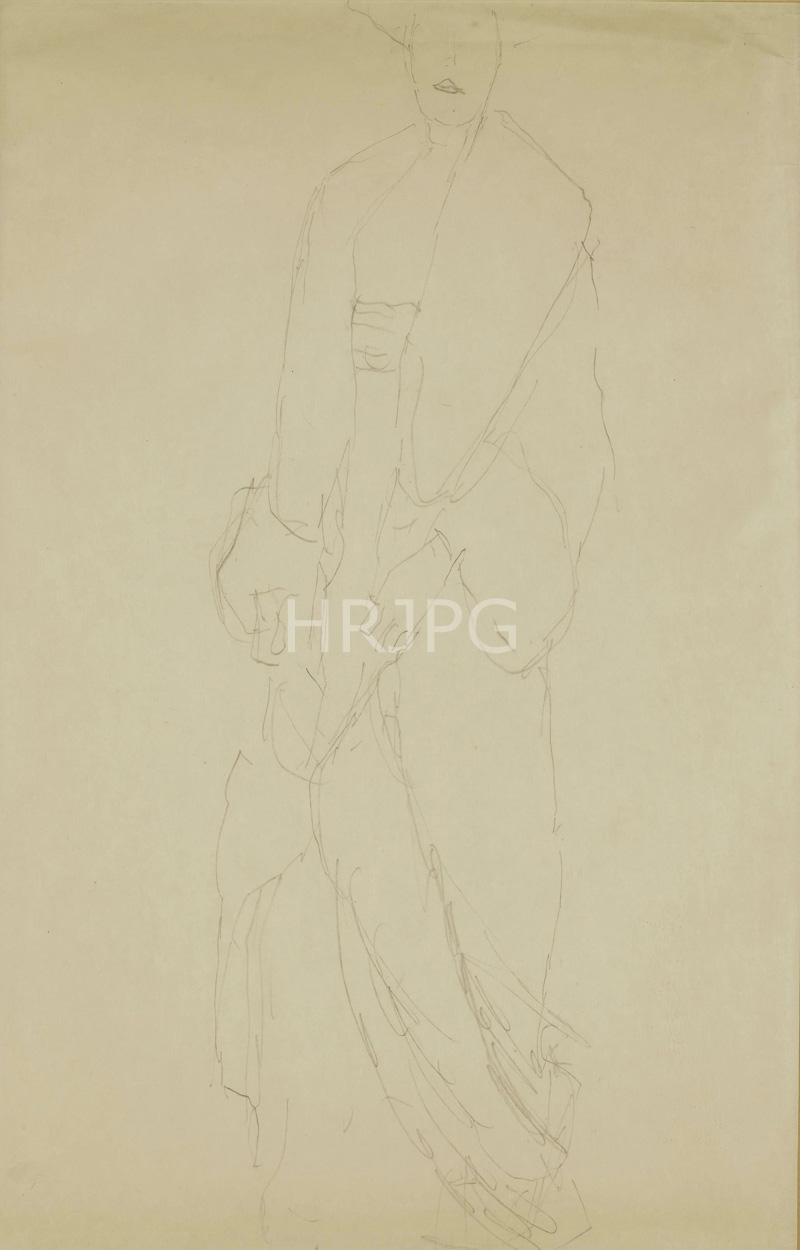
Artist: Gustav Klimt, Year: c. 1912. This elegant pencil drawing is a preliminary study for the second oil portrait of Adele Bloch-Bauer, executed around 1912. Adele was a prominent member of the Viennese Jewish elite and remains the only woman Klimt painted twice in full-length portraits. This study represents a significant stylistic shift from the famous "Golden Phase" portrait of 1907. By 1912, Klimt was moving toward a more "International Style," where the intense gold leaf was replaced by a more painterly focus on color and line. This work showcases his meticulous preparation and his ability to convey noble dignity through purely graphic means.
Technically, the work is defined by its "sophisticated and rhythmic graphic line art." Klimt focuses on Adele’s standing posture and the architectural silhouette of her dress. He utilizes a singular, continuous pencil line to define the contours, varying the pressure to suggest volume and the soft texture of skin without the need for traditional shading. There is a remarkable sense of "linear elegance" here; the artist suggests Adele's individual character and social status through the weight and direction of her pose. The "standing silhouette" creates a sense of monumental presence, utilizing the negative space of the paper to enhance the subject’s "internal focus." The drawing reflects the influence of the younger Expressionist generation, who encouraged Klimt to find a more nervous and emotionally honest quality in his draftsmanship. This focus on "capturing the moment" prioritized psychological truth and linear harmony over academic perfection, making the figure appear both vulnerable and self-assured. The placement of the hands and the tilt of the head are key technical details that Klimt refined across dozens of studies to achieve the perfect balance of grace and authority.
Historically, the Bloch-Bauer family were central to the cultural and intellectual life of "Modern Vienna." Their salon was a hub for artistic activity, and Adele was known for her support of the Secession. This study reflects the "Fin-de-Siècle" search for a new feminine ideal—a move away from the "femme fatale" toward a more realistic and sentient portrayal of women. The relationship between Klimt and Adele was one of mutual respect and creative inspiration, and this drawing captures the "aura" of a woman who was both a patron and a muse.
Art historians have consistently praised these portrait studies for their "technical purity." Critics like Jane Kallir have noted that Klimt’s 1912 drawings show him at his most "sincere," revealing a deep empathy for his subjects. The study is praised for its "sophisticated simplicity," proving that Klimt could achieve a sense of monumental beauty through the most minimal graphic means. Today, it is regarded as a vital document for understanding the anatomical and decorative foundations of his late career, standing as a testament to his unrivaled mastery of the human form.