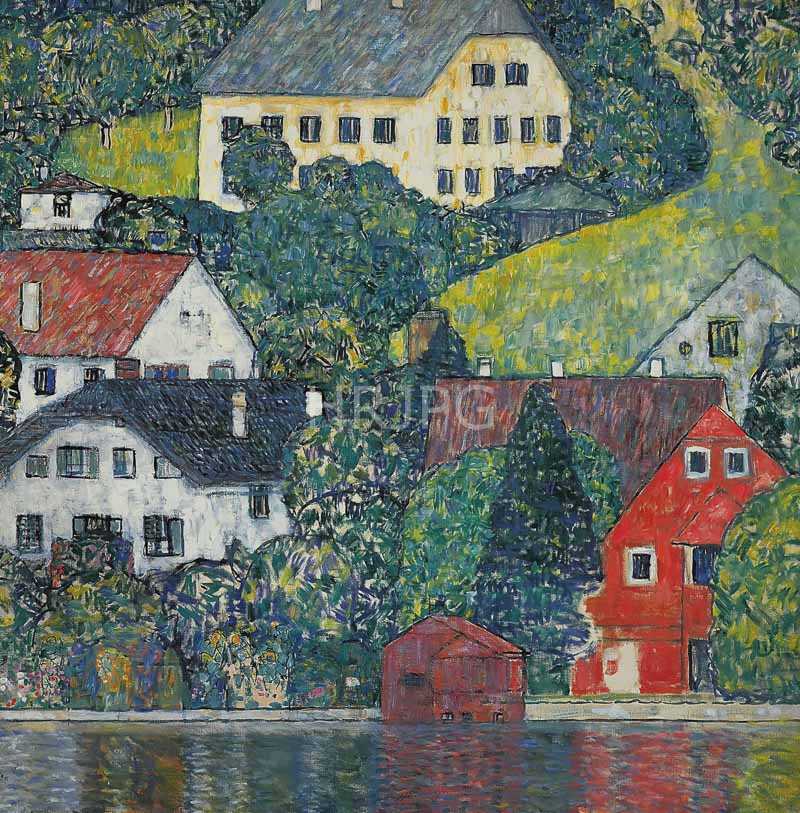
Artist: Gustav Klimt, Year: c. 1916. "Houses at Unterach on the Attersee" is a quintessential example of Klimt’s late mature landscape style, painted during the summer months in the Salzkammergut region. By 1916, Klimt had fully moved away from the metallic gold surfaces of his middle years, embracing a more "painterly" and atmospheric approach. This work celebrates the rhythmic beauty and textured richness of village architecture, presenting it as a harmonious extension of the natural world. Amidst the chaos of World War I, Klimt’s retreats to the Attersee provided a sanctuary of order and aesthetic calm, which is reflected in the serene, static quality of this composition.
Technically, the painting is characterized by its "flattened decorative surface" and the use of an "impressionist mosaic" style. Klimt utilizes a high horizon line and a compressed perspective, likely achieved through the use of a telescope, which brings the village architecture and the lush green hills into a single, shimmering plane. The cluster of colorful houses along the lakefront is rendered as a series of geometric blocks, integrated into the dense tapestry of the foliage. The color palette is dominated by varied, vibrant greens and earthy terracottas, applied with short, rhythmic brushstrokes that create a shimmering effect. This approach prioritizes surface texture and pattern over traditional spatial depth, transforming a topographic view of Unterach into a timeless, highly stylized work of art. The lack of human presence emphasizes the eternal, quiet beauty of the scene, where the architectural and natural elements are unified through a consistent application of light and color.
Historically, the Attersee landscapes were Klimt's most personal works, created for his own satisfaction rather than for public commissions. This period in Vienna was marked by the collapse of the old empire, and Klimt’s focus on the "cultivated nature" of the lakefront reflects a search for stability and beauty in a vanishing world. The work exemplifies the Secessionist ideal of the Gesamtkunstwerk, where every component of a visual environment—from a roofline to a tree trunk—contributes to a unified, modern aesthetic experience.
Art criticism has long lauded these late landscapes for their "extraordinary optical intensity." Critics such as Frank Whitford have noted the "tapestry-like" quality of the work, describing it as a "masterpiece of modern rhythm." The painting is praised for its "innovative design," where the architecture becomes a primary carrier of color. Today, it stands as a testament to Klimt's unrivaled ability to transform a village into a shimmering, eternal mosaic of summer color, bridging the gap between decorative tradition and modern abstraction.