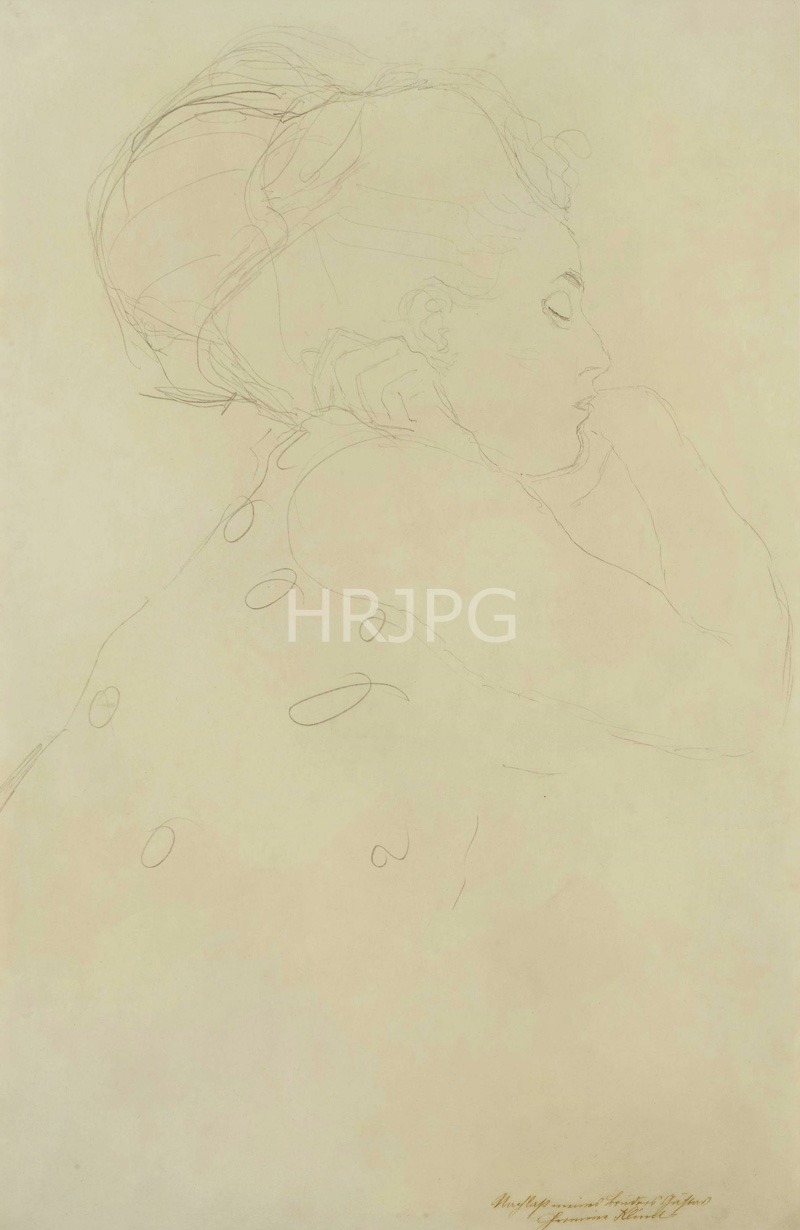
Artist: Gustav Klimt, Year: c. 1917-1918. This refined and evocative pencil drawing, titled "Study for the Bride," was executed by Gustav Klimt during the final months of his life. It serves as a crucial preparatory study for his final major allegorical masterpiece, "The Bride," which remained unfinished in his studio upon his death. This drawing belongs to his late mature period, a time when his graphic work moved away from the ornate decorative patterns of his "Golden Phase" toward a more raw, linear, and psychologically charged aesthetic. It represents the pinnacle of his "Secessionist line," where anatomical truth and linear elegance are synthesized into a profound and modern investigation of character.
Technically, the work is characterized by the "mastery of fluid yet precise lines." Klimt captures the delicate features of a woman in profile, focusing his attention on her "contemplative posture" and the voluminous flow of her hair. He utilizes a singular, continuous pencil line to define the contours, varying the pressure of the lead to suggest volume and the soft texture of skin without the need for traditional shading. The hair is treated as a primary decorative element, rendered as a swirling, rhythmic mass of lines that merge with the silhouette of the body. There is a remarkable sense of "psychological depth" in the study; the woman’s downward gaze and focused expression suggest a state of dreamlike introspection, reflecting the thematic core of the "Bride" project—the exploration of desire and the female spirit. The use of negative space around the figure is strategic, creating a sense of "weightless suspension" that is characteristic of his late allegorical drawings. This "linear economy" allows the gesture itself to become the primary carrier of emotion and mystery, highlighting his ability to convey monumental presence through the most minimal means.
Historically, the "Bride" project was a pivotal moment for Klimt, as he sought to create a "modern secular altarpiece" to the cycle of life. This drawing reflects the intellectual climate of "Fin-de-Siècle" Vienna, which was deeply influenced by the burgeoning field of psychoanalysis and the philosophical writings of Schopenhauer. The work captures the "somber, reflective mood" of the war years, as Klimt retreated into the private world of his studio to find solace in the study of beauty. It marks the culmination of his lifelong fascination with the feminine form, moving away from the "femme fatale" toward a more realistic and empathetic view of women.
Art historians have consistently praised these late "Bride" studies for their "technical purity" and "modernity." Critics like Jane Kallir have argued that Klimt’s final drawings show him at his most "authentic," revealing a deep empathy for his models. The study is praised for its "melodic quality" and its ability to capture a sense of "timeless grace" through the elegance of a single line. Today, it remains a vital document for understanding the anatomical and decorative foundations of his final masterpiece, standing as a testament to Klimt's unrivaled ability to capture the "aura" of a person through the sheer power of draftsmanship. It is regarded as a masterpiece of modern graphic expression, bridging the gap between decorative tradition and modern psychological depth.