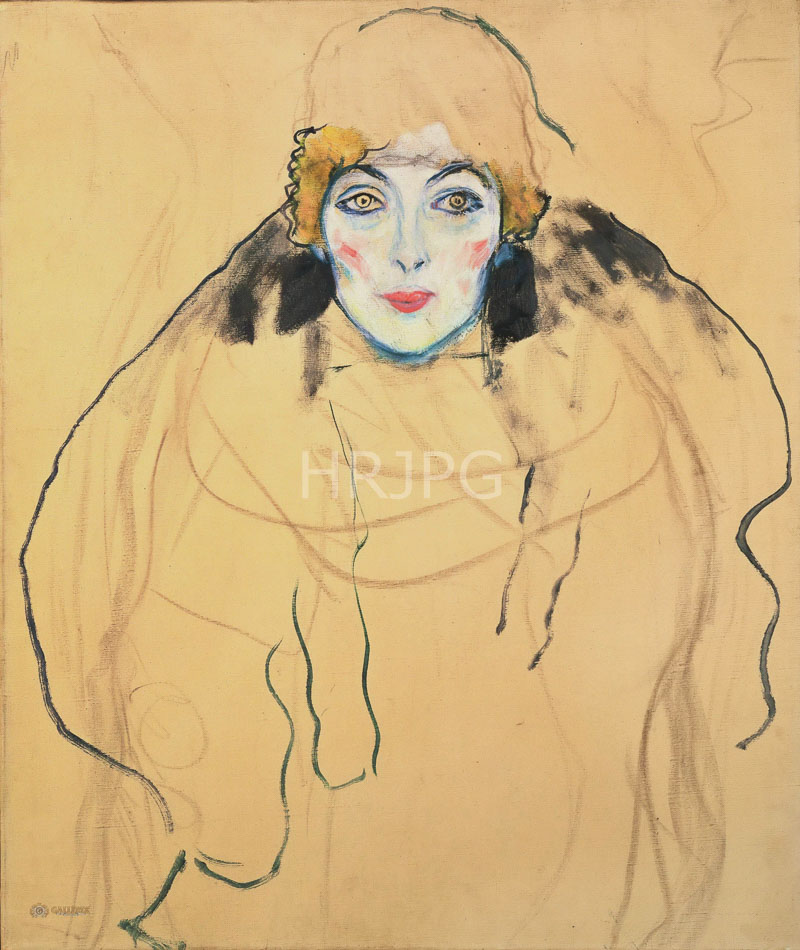
Artist: Gustav Klimt, Year: 1917-1918. The "Portrait of a Lady" was executed by Gustav Klimt during his final years and remained unfinished at the time of his death. This work offers a unique and moving insight into the creative process of the master, revealing the raw layers of his late mature style. Unlike the meticulously polished works of his "Golden Phase," this canvas shows the artist’s hand in motion, moving from the initial charcoal underdrawing to the first expressive washes of oil. It captures the "serene expression" and the vibrant personality of the subject through a more "human and unvarnished" lens, reflecting the transition toward a more painterly and modern aesthetic.
Technically, the painting is celebrated for its "luminous skin tones" and the expressive layering of color. Klimt depicts the woman’s head and shoulders with a focus on her "serene expression" and her vibrant blue eyes, which serve as the psychological focal point of the work. He utilizes a range of soft, warm skin tones that contrast with the more gestural, unfinished areas of her garments and the background. The "unfinished" nature of the gown provides a rare glimpse into how Klimt planned to integrate decorative patterns, using broad, rhythmic strokes that suggest he was moving toward a more "International Style." The composition is intimate and vertical, pushing the figure to the front of the picture plane. The use of color is atmospheric and subjective, prioritizing "mood" over topographic detail. This "non-finito" approach allows the viewer to see the "vibrancy of the paint" and the anatomical logic behind the final ornament. The lack of a finished background creates a dreamlike, ethereal space that highlights the subject’s internal focus and quiet dignity, proving that Klimt’s brilliance was rooted in his ability to capture the "aura" of a person.
Historically, the identity of the sitter is a subject of debate, but the work was part of a group of unfinished canvases found in his studio following his death in 1918. This was a period of intense social collapse for Vienna, yet Klimt’s studio remained a sanctuary where he could explore universal themes of beauty. The painting captures the spirit of a city on the brink of profound change, viewed through the lens of a man who was himself at the end of a legendary career. It reflects the influence of the Expressionists on his late work, where the "emotional truth" became more important than decorative perfection.
Art criticism has long highlighted the "modernity" of this unfinished portrait. Critics have noted that the visible sketching provides a "cinematic" quality, showing the artist’s process of "searching for the form." The painting is praised for its "unvarnished sincerity," standing as a masterpiece of potentiality. Today, it remains a vital reference for the study of his late technique, standing as a beautiful reminder of a creative journey cut short. It is regarded as a masterpiece of his final expressive style, celebrating the resilience of the human spirit through its luminous and serene incomplete form.