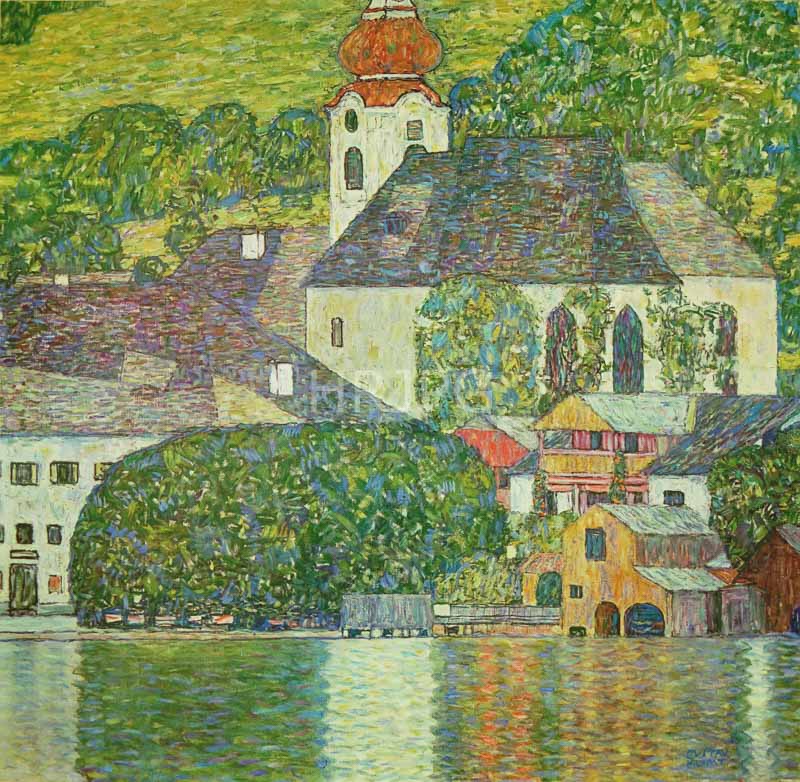
Artist: Gustav Klimt, Year: 1916. The late landscape "Church in Unterach on the Attersee" was painted by Gustav Klimt during his final years, produced during his summer retreats to the Lake Attersee region. This work is a premier example of his "International Style," where the rigid gold surfaces of his middle years were replaced by a more "painterly and architectural" approach to the landscape. Amidst the gathering shadows of World War I, Klimt retreated into the "tranquil rhythms" of the Austrian countryside, and this painting serves as a profound celebration of that rural beauty and the architectural harmony of the village.
Technically, the composition is characterized by its "compressed perspective" and its extraordinary density of detail. Klimt utilizes a "high horizon line," pushing the lake to the very bottom edge and the distant hills to the very top, which forces the viewer's eye to remain fixed on the "mosaic of rooftops" and foliage. The village of Unterach is integrated into the natural environment so perfectly that the architectural elements appear as organic components of the pattern. He utilizes a palette dominated by vibrant, deep greens and warm terracotta tones for the rooftops, applied with a "mosaic-like" technique influenced by Pointillism. This approach creates a "flattened decorative surface" that emphasizes rhythm and texture over three-dimensional depth, transforming a topographic view into a timeless, highly stylized work of art. A key technical detail is the use of a telescope to achieve this "telescopic" flattening of space, allowing him to organize the "dense jewel-like pattern" of rooftops into a harmonious whole. This "all-over" composition forces the eye to wander through the textured richness of the paint, mirroring the immersive qualities of the natural world.
Historically, 1916 was a year of profound personal and political transition for Klimt. His landscapes were his most private works, created for his own satisfaction. The focus on the village church reflects his close connection to the region and his search for stability amidst the social collapse of the Austro-Hungarian Empire. This period saw Klimt influenced by the works of the early Expressionists, leading to a more subjective and emotionally charged use of color. The work exemplifies the Secessionist ideal of the Gesamtkunstwerk, where even a simple village church is treated as a component of a total, modern work of art.
Art criticism has long lauded "Church in Unterach" for its "extraordinary decorative intensity." Critics such as Frank Whitford have noted the "tapestry-like" quality of the work, describing it as a "landscape of light." The painting is praised for its "innovative design," where the architecture becomes a primary carrier of color and rhythm. Modern scholars highlight the work as a masterpiece of early 20th-century landscape art, noting its profound influence on the later developments of modern decorative modernism. Today, it remains a celebrated part of his repertoire, standing as a testament to his ability to transform a village into a shimmering, eternal mosaic of summer color.