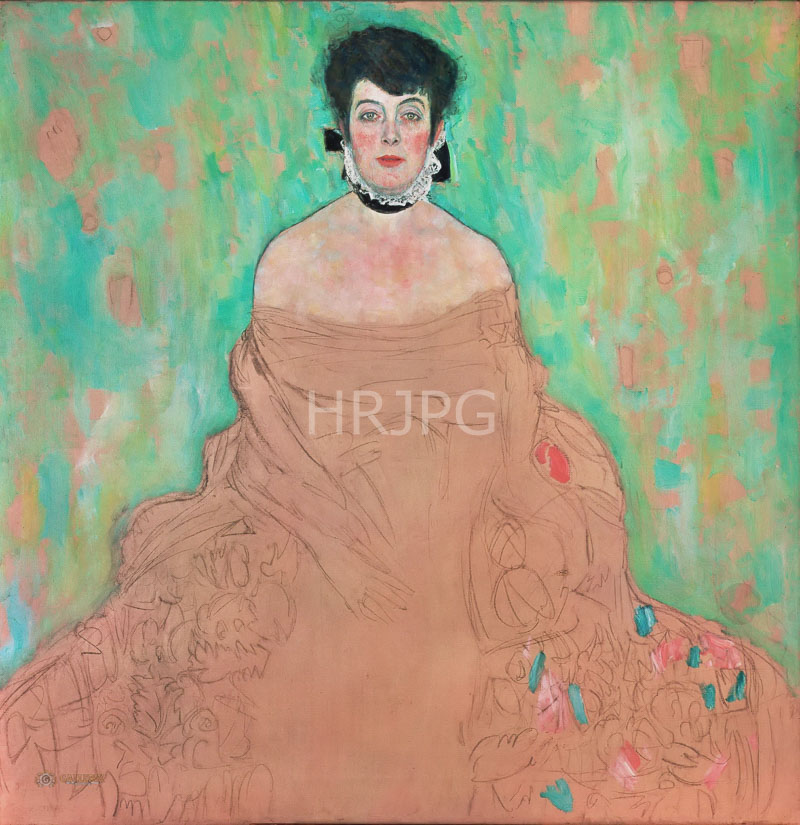
Artist: Gustav Klimt, Year: 1917-1918. The monumental oil portrait of "Amalie Zuckerkandl" was painted by Gustav Klimt during the final years of his life and remained unfinished at the time of his death. Amalie was a prominent member of the Viennese Jewish elite and part of a family that was among Klimt’s most significant late-period patrons. This work is a premier example of his "International Style," where the rigid gold surfaces of his middle years were replaced by a more painterly and expressive focus on color and texture. Amidst the gathering shadows of World War I, this portrait captures the personality and social status of a modern Viennese woman through a sophisticated decorative lens.
Technically, the painting is a masterclass in "expressive layering" and the synthesis of realistic modeling and decorative abstraction. Amalie’s face and torso are rendered with soft, three-dimensional modeling, capturing her intelligent and slightly melancholic expression with extreme sensitivity. However, her gown and the surrounding background are transformed into a "dense mosaic of decorative motifs." Because the work is "unfinished," we can see how Klimt planned to integrate intricate patterns and floral symbols into the textiles, using gestural strokes that suggest he was moving toward a more painterly aesthetic. The composition is vertical and balanced, using the "pattern" as an architectural framework that supports the subject. Klimt utilizes a "compressed perspective" and a high horizon line, pushing the figure to the very front of the picture plane. The contrast between the "luminous skin tones" and the vibrant, unfinished patterns creates a sense of "ethereal beauty" and psychological presence. This approach illustrates his mastery in conveying the "aura" of a person through a unified and modern ornamental elegance.
Historically, the Zuckerkandl family were central to the intellectual life of "Modern Vienna." Their salon was a hub for artistic activity, and Amalie was known for her support of the Secession. The "unfinished" nature of the work provides a unique insight into his creative process, showing the raw charcoal underdrawing and the initial washes of color. This period in Vienna was marked by the collapse of the old empire, and Klimt’s focus on the portrait reflects the resilience of beauty in the face of historical change. The painting also has a complex legacy, as Amalie and her daughter later suffered during the Nazi era, turning the work into a poignant symbol of a lost world.
Art criticism has long identified "Amalie Zuckerkandl" as one of Klimt’s most "sincere" late works. Critics such as Jane Kallir have noted that the "unfinished" state of the painting provides a "cinematic" quality, showing the artist’s hand in motion. The painting is praised for its "psychological gravity," as her focused gaze provides a point of stillness amidst the potential for ornamentation. Today, it is regarded as a late masterpiece of his mature style, standing as a testament to Klimt's unrivaled ability to transform a societal commission into a shimmering, eternal mosaic of human life and modern dignity.