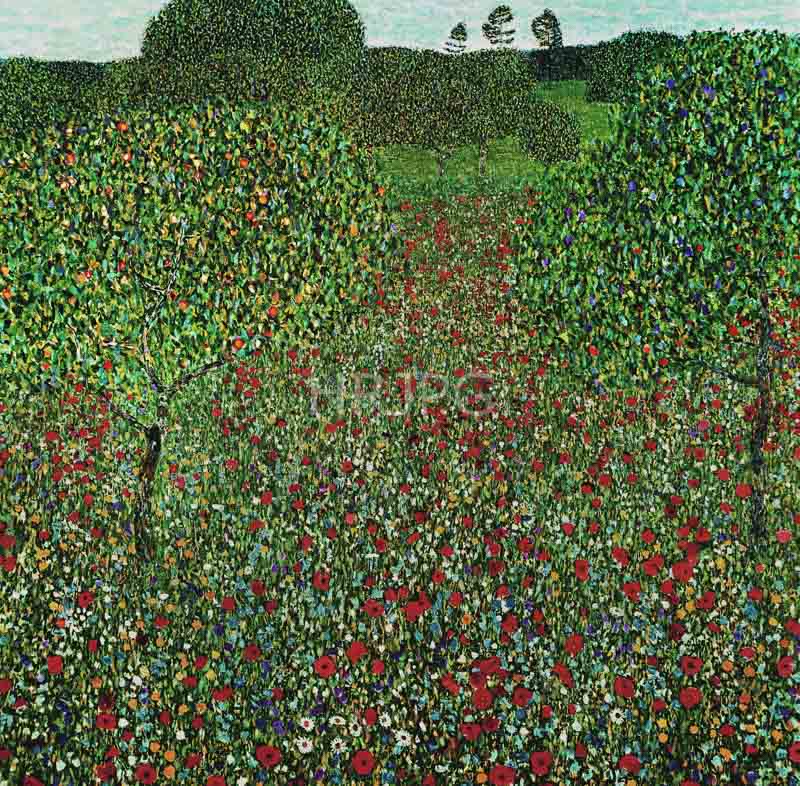
Artist: Gustav Klimt, Year: 1907. The vibrant and lush oil landscape "Poppy Field" was painted by Gustav Klimt in 1907, during the absolute pinnacle of his "Golden Phase." This work is a premier example of his "immersive landscapes," produced during his summer retreats to Lake Attersee. During this period, Klimt was increasingly fascinated by the idea of nature as a "dense tapestry" of light and color, leading him to create works that blurred the line between naturalistic observation and decorative Symbolism. This painting serves as a visual manifestation of the Secessionist ideal of the Gesamtkunstwerk, where every element of the natural world is woven into a single, shimmering, and modern aesthetic experience.
Technically, the composition is a masterclass in "mosaic-like pointillism" and the use of the square format. Klimt fills the square canvas with a dense field of poppies and wildflowers, effectively eliminating any middle ground. He utilizes a "high horizon line," pushing the sky to the very top edge of the canvas, which forces the viewer to appreciate the rhythmic organization of the foliage. The "poppies" are rendered as thousands of tiny, vibrant dabs of red paint, nestled within a shimmering green field. Klimt utilizes a "mosaic-like" technique to create a surface that vibrates with color and light, emphasizing the decorative texture of the paint over traditional depth. The space is purposefully "flattened," inspired by Japanese woodblock prints and Byzantine mosaics. This approach forces the eye to wander through the "rich tapestry of shimmering tones," mirroring the sensory overload of a summer day. The lack of a clear focal point or human presence emphasizes the eternal, static beauty of nature, which was a hallmark of his nature studies.
Historically, 1907 was a year of intense creative output for the Secession. This work reflects the group's commitment to "total art" and the elevation of decorative painting to the status of fine art. The painting was purchased for a prominent collection, illustrating the close relationship between Klimt’s vision of nature and the aesthetic desires of the Viennese upper class. It captures the spirit of "Fin-de-Siècle" Vienna, a culture that sought refuge in the beauty of the natural world from the growing complexities of urban life. The focus on the "shimmering surface" reflects the Symbolist belief that the surface was a carrier of spiritual truth.
Art historians have consistently praised "Poppy Field" for its "extraordinary decorative intensity." Critics such as Frank Whitford have noted that Klimt’s landscapes are "purely optical experiences," where the eye is invited to wander through a forest of color. The painting is praised for its "innovative synthesis" of Impressionist light and Secessionist design. Modern scholars often point to this work as a masterpiece of early 20th-century Symbolism, noting its profound influence on the development of modern decorative art. Today, it remains one of the most beloved works in his landscape repertoire, standing as a testament to Klimt's ability to see the extraordinary and sacred beauty within the density of a summer meadow.