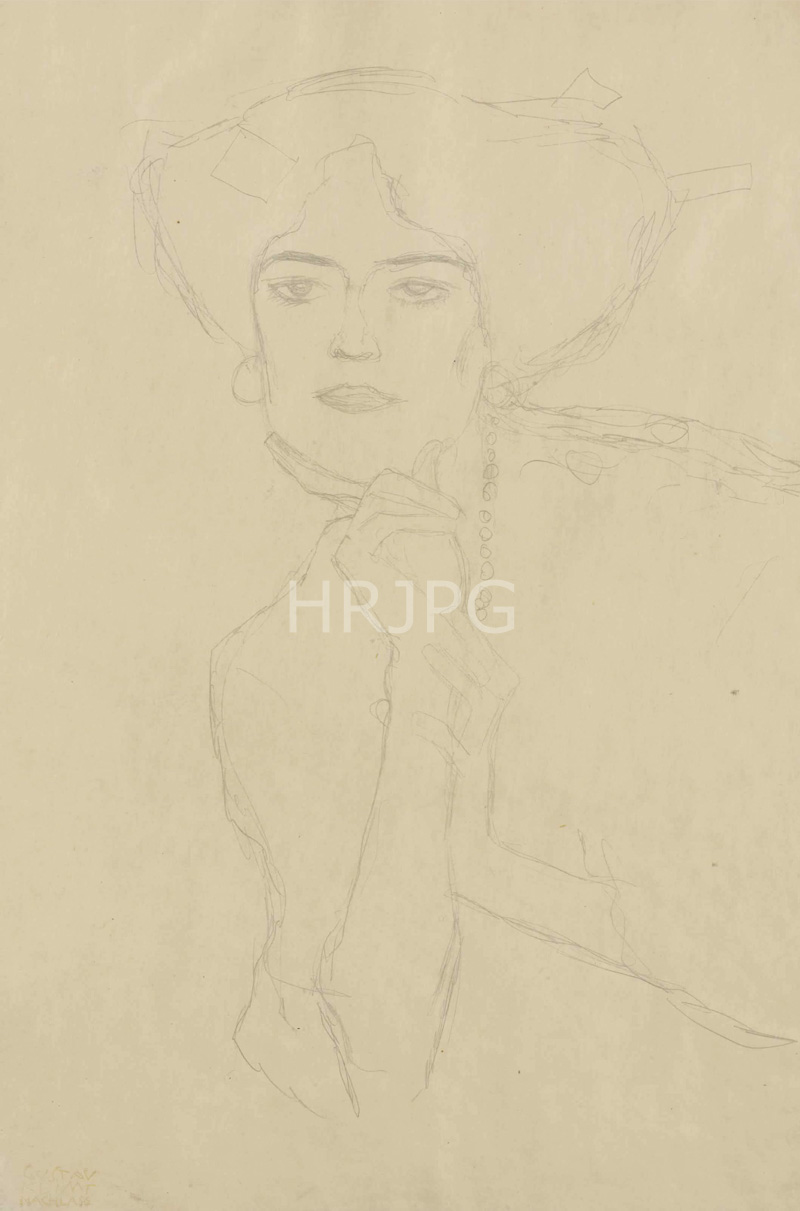
Artist: Gustav Klimt, Year: c. 1916. This delicate and evocative pencil drawing, titled "Portrait of a Woman," was executed by Gustav Klimt around 1916. It belongs to his late mature period, a time when his graphic work achieved its most "expressive and personal" stage. During these final years, Klimt retreated from the monumental, gold-laden paintings of his middle career to focus on the raw, psychological intensity of the human form within his private studio practice. This work is a quintessential example of his "unvarnished exploration" of character, rendered with a level of linear elegance and emotional honesty that was radical for its time.
Technically, the work is defined by its "mastery of fluid and sensitive line work." Klimt captures the woman in a three-quarter profile, utilizing a singular, continuous pencil line to define the contours of her face and the voluminous structure of her hair. There is a remarkable sense of "linear economy" here; he suggests the weight and volume of the head with a minimum of graphic expression. The lines are remarkably confident, varying in thickness to suggest the soft transitions of light across the skin. By omitting any background detail or environmental context, Klimt forces the viewer to focus entirely on the "physical truth" and the "inner feeling" of the subject. The "three-quarter profile" is a key technical detail, creating a sense of depth and contemplative distance. The use of the white paper as a luminous field enhances the sense of the figure's "weightless suspension," making the drawing appear both intimate and monumental. This approach reflects his transition from academic realism toward a more "subjective and sensitive" Symbolist graphic style, where the line itself becomes a carrier of spiritual and psychological depth.
Historically, these late portrait studies reflect the changing moral and intellectual climate of war-time Vienna. Influenced by the radical ideas of the Expressionists, Klimt sought to represent the "hidden, unconscious life" of his subjects. While his public works were often highly stylized, his drawings were a sanctuary of "honesty." This period saw Klimt moving toward a more "human" representation of women, reflecting his personal relationships and his ongoing rebellion against academic tradition. These works were essential to his development, serving as a laboratory for the formal experiments that would appear in his final, unfinished paintings.
Art criticism has long identified Klimt’s late drawings as some of the most important graphic works of the early 20th century. Critics like Jane Kallir have argued that these works show Klimt at his most "sincere," revealing a deep empathy for his subjects. "Portrait of a Woman" is praised for its "melodic quality" and its ability to convey a sense of "monumental beauty" through minimal means. Today, it remains a vital reference for understanding the development of modern figurative art, standing as a testament to his unrivaled ability to capture the complex, intimate, and sacred landscape of the human spirit through a single, elegant line.