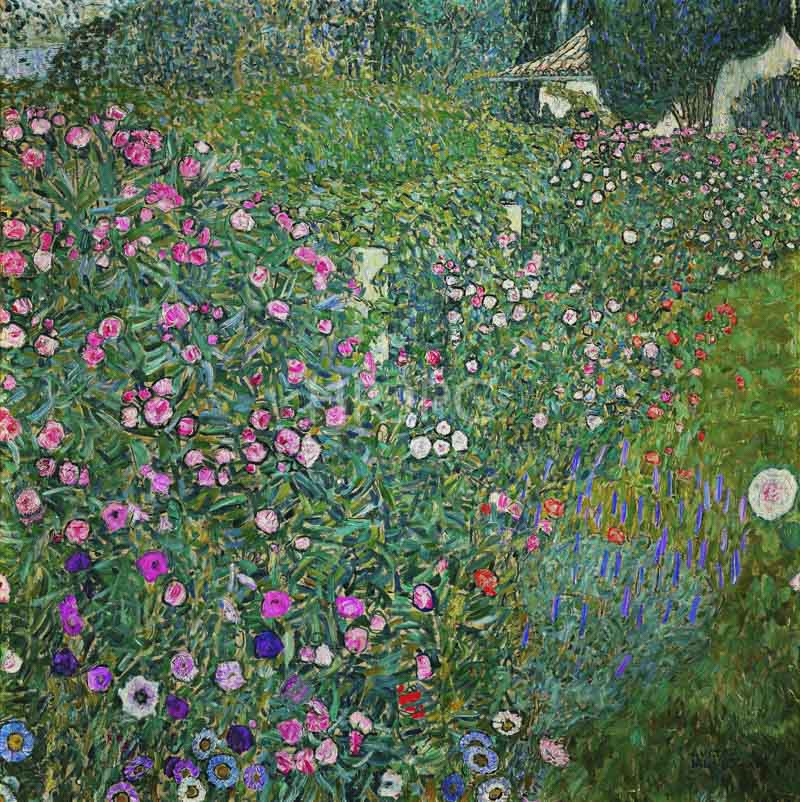
Artist: Gustav Klimt, Year: 1913. The lush and vibrant "Italian Horticultural Landscape" was painted by Gustav Klimt in 1913 during a rare trip to Lake Garda, Italy. This work belongs to his mature "International Style," where he began to move away from the gold ornamentation of his middle years to explore a more painterly and architectural representation of nature. This painting is a profound celebration of the Mediterranean environment, transforming a dense horticultural garden into a shimmering, decorative tapestry that reflects his late mature landscape style.
Technically, the composition is characterized by its "compressed perspective" and its extraordinary use of vibrant color. Klimt utilizes a high horizon line, pushing the sky and the distant hills to the very top edge of the canvas, which forces the viewer's eye to remain fixed on the "mosaic of flowers" and greenery. The garden is organized into a dense, vertical pattern of textures and colors. He utilizes a palette dominated by deep, lush greens and vibrant floral accents, applied with rhythmic brushstrokes influenced by Pointillism. This approach creates a "flattened decorative surface" that emphasizes pattern and texture over traditional spatial perspective and depth. The way the architectural elements of the garden are integrated into the foliage illustrates Klimt’s ability to synthesize man-made and natural structures into a single, unified aesthetic vision. The use of light is purely optical, capturing the shimmering atmosphere of an Italian summer without relying on traditional chiaroscuro.
Historically, 1913 was a year of international consolidation and intense creative output for Klimt. The trip to Italy provided him with a new light and a different botanical rhythm, which he successfully synthesized with his own Secessionist aesthetic. The work reflects the "Fin-de-Siècle" search for order and tranquility amidst the growing social and political instability of pre-war Europe. It exemplifies the concept of the Gesamtkunstwerk, where every component of the scene—from a single leaf to a garden wall—contributes to a unified, modern aesthetic experience.
Art criticism has long lauded "Italian Horticultural Landscape" for its "extraordinary decorative intensity." Critics such as Frank Whitford have noted the "Cubist-adjacent flattening" of the work, describing it as a "tapestry of color." The painting is praised for its "innovative synthesis" of Italian scenery and Viennese design, proving that Klimt’s brilliance was rooted in his ability to see the world as a shimmering, organized whole. Today, it stands as a masterpiece of early 20th-century landscape art, demonstrating his unrivaled ability to transform a simple garden into a shimmering, eternal mosaic of summer color.