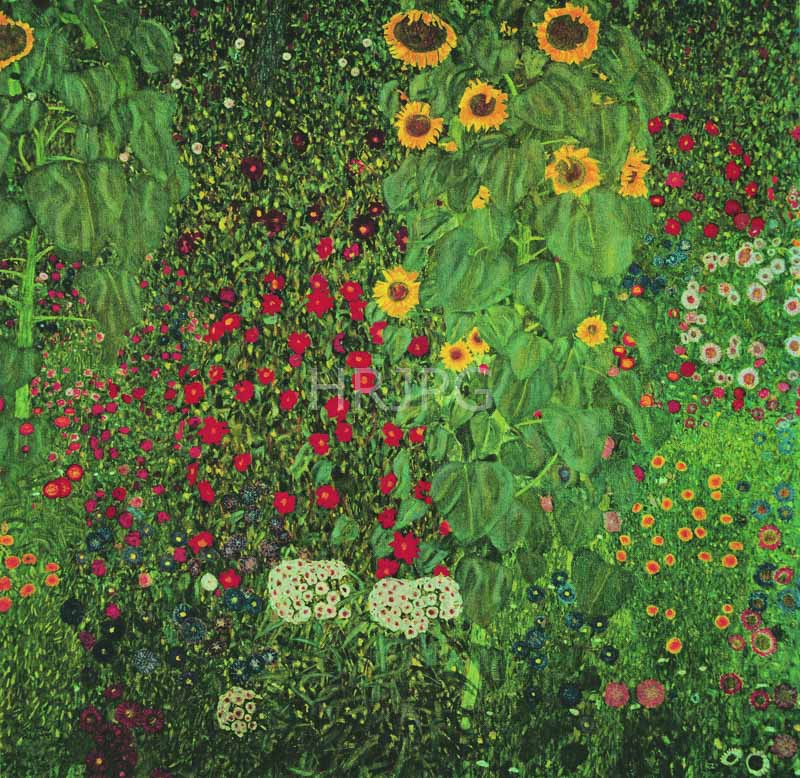
Artist: Gustav Klimt, Year: 1905-1906. The vibrant oil painting "Farm Garden with Sunflowers" is a premier example of Klimt’s "Golden Phase" landscapes, produced during his summer retreats to Lake Attersee. During this period, Klimt sought a synthesis between the radical decorative principles of the Secession and the raw, unmediated abundance of nature. This work is celebrated for its immersive quality, transforming a rustic garden into a shimmering tapestry of light and color that reflects the artist's search for "total harmony" within the natural world.
Technically, the composition is defined by its "radical density" and the lack of a traditional focal point. Klimt fills the entire square canvas with a lush arrangement of sunflowers and colorful blossoms, effectively eliminating any sense of sky or distant perspective. This creates a "flattened decorative surface" that forces the viewer's eye to wander through the rhythmic brushstrokes. He utilizes a sophisticated version of Pointillism, where thousands of tiny "mosaic-like" dabs of paint create a vibrating effect that captures the play of light without relying on realistic modeling. The color palette is extraordinarily rich, featuring a symphony of greens, yellows, and vibrant floral reds. The sunflowers act as stable vertical anchors against the swirling patterns of the surrounding flowers, creating a sense of "architectural order" within the organic chaos. This "all-over" approach—influenced by Japanese prints and Byzantine mosaics—unifies the diverse natural elements into a single, shimmering work of art.
Historically, the year 1905 was a time of intense personal and professional success for Klimt. His landscapes were his most private works, created for his own satisfaction. The focus on the "Hortus Conclusus" (enclosed garden) reflects the "Fin-de-Siècle" search for refuge from the growing complexities of urban life. The work exemplifies the Secessionist ideal of the Gesamtkunstwerk, where every component of the scene—from a single petal to a sunflower stalk—contributes to a unified, modern aesthetic experience.
Art criticism has long celebrated "Farm Garden with Sunflowers" for its "optical brilliance" and its innovative design. Critics such as Frank Whitford have noted the "jewel-like intensity" of the work, describing it as a "tapestry of life." The painting is praised for its "modernity," prefiguring the later move toward total abstraction by treating the landscape as a vehicle for pure color and rhythm. Today, it remains a cornerstone for understanding the evolution of his landscape style, standing as a testament to his ability to see the sacred and decorative beauty within the simplest rustic scene.