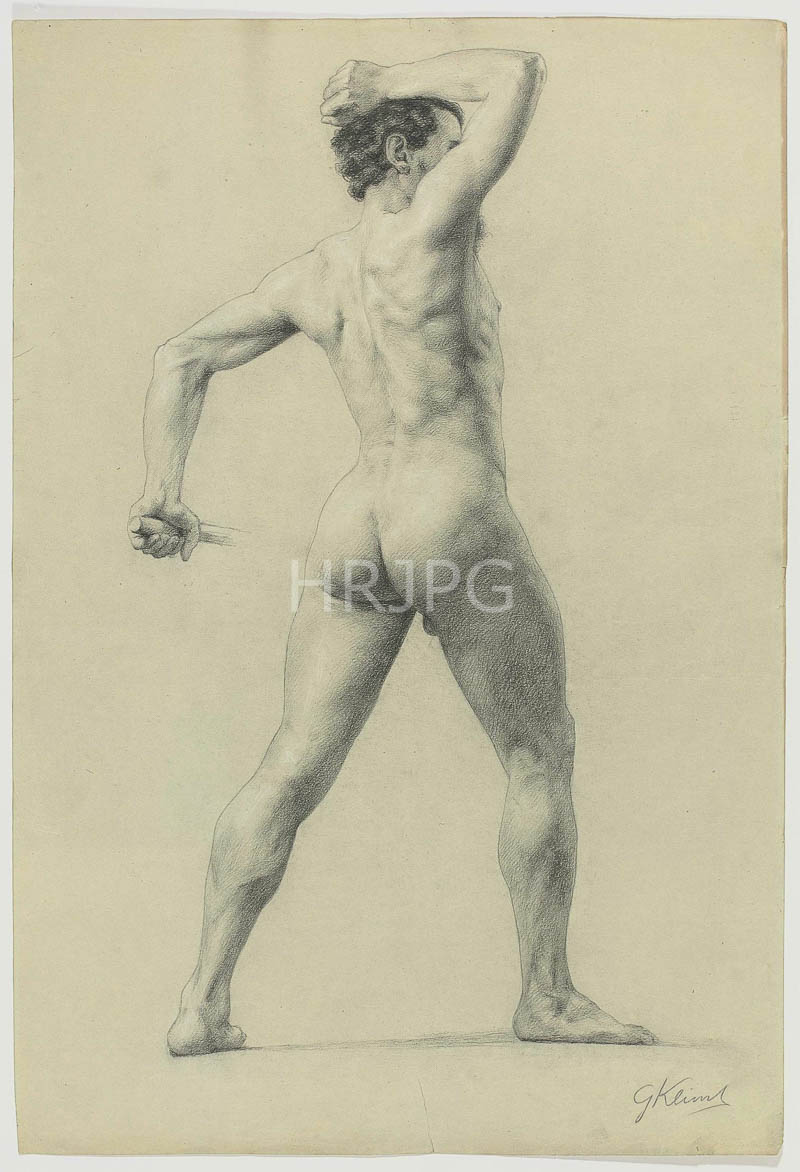
The extraordinary and historically significant "Male Nude from Back" was produced by Gustav Klimt around 1880. This work is a premier example of his "Early Academic Period," created while he was a brilliant student at the Vienna School of Arts and Crafts (Kunstgewerbeschule). During these early years, Klimt was part of the "Künstlercompagnie" (Artists’ Company), where he was trained in the rigorous traditions of "Historical Realism" and classical figure painting. This study represents the "foundational genius" of the young artist, showcasing his ability to capture the weight, volume, and anatomical truth of the human form long before his radical break with the academic establishment and the founding of the Vienna Secession.
Technically, the work is characterized by its "remarkable anatomical precision" and its masterful use of light and shadow. Klimt depicts a muscular male nude from behind, focusing his attention on the complex structure of the back, shoulders, and spine. He utilizes "refined lighting" and subtle shading to define the three-dimensional volume of the muscles, creating a sense of physical weight and power that is both monumental and realistic. The drawing is a masterclass in "chiaroscuro," where the soft transitions of tone capture the texture of the skin and the structural truth of the bone beneath. Unlike the flattened and stylized forms of his later "Golden Phase," this study focuses on "precisely modeled forms" and a deep understanding of classical anatomy. The composition is simple and formal, prioritizing the "objective recording" of the body’s movement and structure. This focus on "anatomical clarity" reflects the influence of the "Great Academic Tradition" of Hans Makart, proving that Klimt’s eventual move toward abstraction was a deliberate evolution from a profound and comprehensive mastery of traditional techniques.
Historically, 1880 was a year of early professional promise for the young Klimt. He was already receiving commissions for public decorations and was seen as a future star of the academic establishment. "Male Nude from Back" reflects the cultural values of the Ringstrasse era—a society that valued order, classical beauty, and the glorification of human strength. The study serves as a vital record of the "formal foundations" that allowed Klimt to eventually transcend realism and invent a modern artistic language. It captures the spirit of a young artist at the height of his "academic purity," just before the "Fin-de-Siècle" intellectual climate would lead him toward Symbolism and the mysteries of the psyche.
Art historians have consistently praised this early study for its "prodigious technical mastery." Critics have noted the "Old Master" quality of the drawing, comparing Klimt’s handling of the human form to the works of the Renaissance masters like Michelangelo. The work is celebrated today for its "monumental realism," a quality that provides a fascinating contrast to the "femme fatales" and decorative patterns of his later career. Modern scholarship highlights the study as a crucial document of Klimt’s early career, proving that his brilliance was rooted in a deep and profound understanding of human sensitivity and physical reality. Today, it remains a beloved part of private and museum collections, standing as a testament to the artist's ability to see and represent the extraordinary grace within the human form.