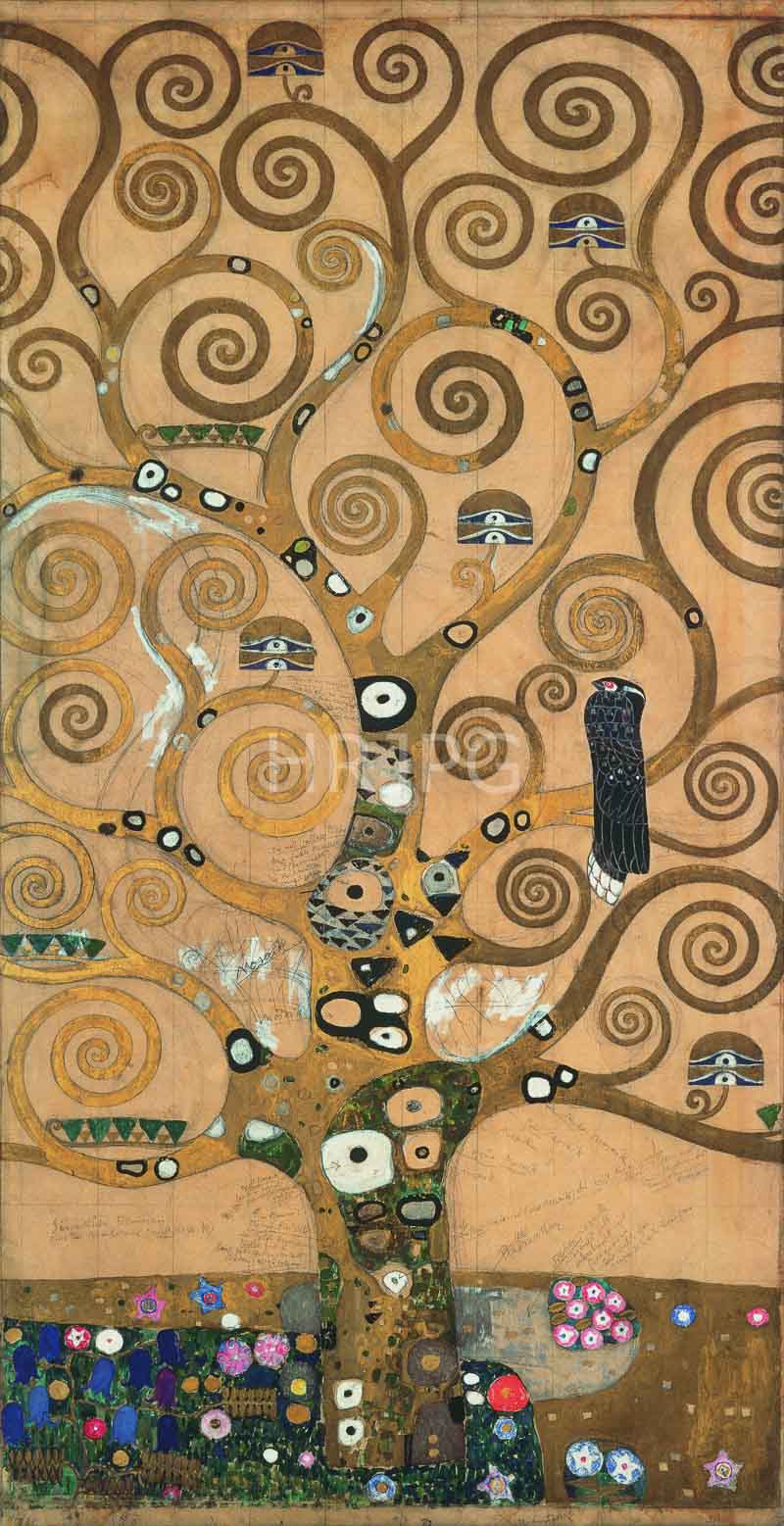
The symbolic and monumental composition "The Tree of Life" was created by Gustav Klimt between 1905 and 1909 as part of the "Stoclet Frieze." This work was a central component of the interior decoration for the Palais Stoclet in Brussels, a private mansion designed by the architect Josef Hoffmann for the industrialist Adolphe Stoclet. This project represents the pinnacle of the "Secessionist ideal" of the Gesamtkunstwerk (total work of art), where architecture, painting, and the decorative arts were fused into a single modern environment. "The Tree of Life" serves as a profound allegory of the cycle of existence, growth, and the interconnectedness of all living things, reflecting the most sophisticated aesthetic of the Vienna Secession.
Technically, the work is a masterclass in the use of "gold leaf and intricate decorative motifs." Klimt depicts a sprawling tree with swirling, spiraling branches that fill the entire horizontal space of the frieze. These "swirling branches" are adorned with a dense mosaic of symbols—eyes, triangles, and flowers—inspired by Egyptian art and Byzantine mosaics. The "jewel-like surface" is achieved through a combination of paint, gold leaf, and possibly semi-precious materials, creating a visual vibration that captures and reflects light. The composition unifies "naturalistic inspiration" with a highly "modern abstraction," where the tree is both a biological entity and a complex geometric design. A key technical detail is the inclusion of the "Black Bird of Death" perched in the branches, which adds a layer of "memento mori" to the celebration of life. The "flattened decorative surface" pushes the imagery to the very front of the plane, turning the wall into a shimmering, modern icon. This approach illustrates Klimt's mastery in integrating "architectural design" with symbolic narrative, creating a work that is both a decorative ornament and a profound philosophical statement.
Historically, the Stoclet Frieze project was the only major commission Klimt executed outside of Austria. It reflects the international reach of the Wiener Werkstätte and its goal to bring "total art" to the private domestic sphere. The "Tree of Life" motif is a universal symbol, but Klimt reimagines it through the lens of "Fin-de-Siècle" Symbolism, exploring themes of "eternal return" and the psychological depths of growth. The work captures the spirit of "Modern Vienna"—a city that sought to find a "sacred meaning" in the beauty of the surface, where the ornament was seen as a carrier of cosmic truth.
Art historians have consistently praised "The Tree of Life" for its "extraordinary imaginative power." Critics such as Frank Whitford have noted the "monumental elegance" of the work, describing it as a "masterpiece of modern design." The painting is praised for its "innovative synthesis" of materials and meaning, proving that Klimt could achieve a sense of monumental beauty through a highly stylized and decorative visual language. Today, it remains one of the most iconic and beloved works in his repertoire, standing as a testament to his unrivaled ability to transform a private wall into a shimmering, eternal mosaic of human life and nature’s mystery.