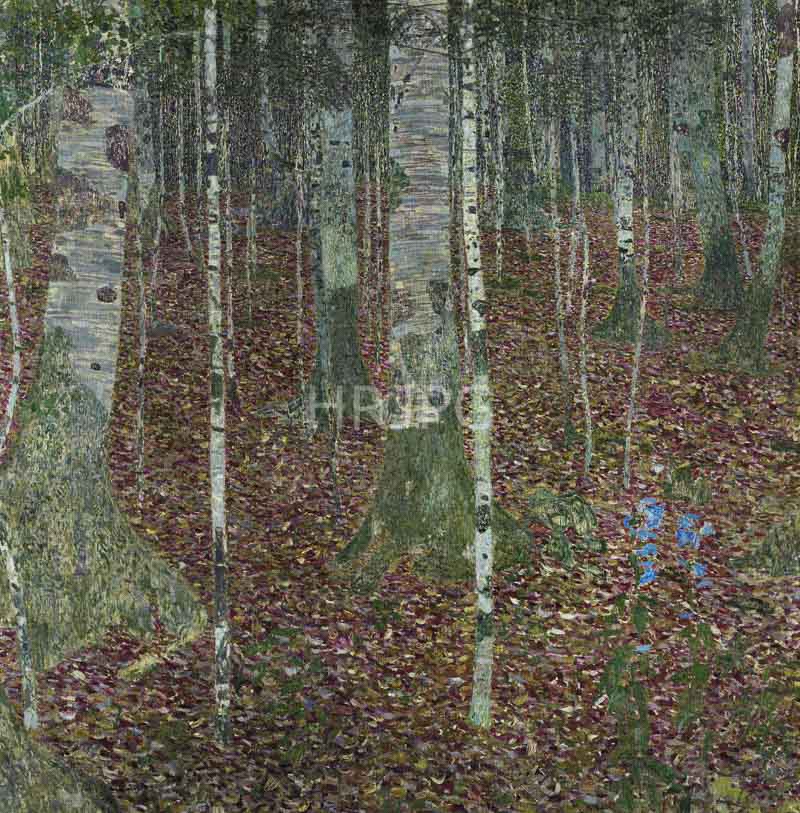
The enchanting oil landscape "Beech Forest" (also known as "Birch Forest") was painted by the Austrian master Gustav Klimt in 1903. This work is a cornerstone of his landscape repertoire, created for the major "Klimt Exhibition" at the Vienna Secession that same year. During this period, Klimt was increasingly seeking a "new path" for landscape painting, moving away from traditional topography toward a more personal and Symbolist vision of nature. "Beech Forest" represents a significant moment in this evolution, where the natural world is transformed into a shimmering, decorative tapestry that reflects the Secessionist search for "total harmony" and spiritual quietude.
Technically, the composition is defined by its "rhythmic pattern of tree trunks" and the lack of a traditional focal point. Klimt fills the square canvas with the dense, vertical forms of the forest, effectively eliminating any sense of sky or distant horizon. This "all-over" composition—influenced by Japanese prints and Belgian Symbolism—creates an "immersive mosaic-like effect" that forces the viewer's eye to wander through the vertical lines of the trunks and the textured carpet of fallen leaves. He utilizes a rich "autumnal palette" of ochre, russet, and deep greens, applied with short, mosaic-like brushstrokes. This technique allows Klimt to emphasize "surface texture" over three-dimensional depth, capturing the "play of light" within the dense woods without relying on traditional perspective. The "vibration of the paint" creates a shimmering effect that heightens the work's sense of "decorative intensity" and spiritual presence. By flattening the space, Klimt transforms the forest into a "secular cathedral," where the rhythmic repetition suggests a sense of cosmic order and eternal cycle. The square format of the canvas provides a sense of modern balance, creating a "unified aesthetic whole" where the viewer feels completely enveloped by the natural world.
Historically, 1903 was a year of immense creative output and professional success for Klimt. His summer retreats to the Attersee provided a necessary mental escape from the intense public controversies surrounding his "Faculty Paintings." This work reflects the influence of the "Scandinavians" and the "Symbolists" on the Secessionist aesthetic, particularly their focus on the "shimmering surface" as a carrier of spiritual meaning. The painting captures the spirit of "Fin-de-Siècle" Vienna, a culture that sought refuge in the beauty and permanence of nature from the rapid changes of the modern city.
Art historians have long celebrated "Beech Forest" for its "extraordinary atmospheric quality." Critics such as Frank Whitford have noted the "obsessive observation" and the "ornamental harmony" of the work, describing it as a landscape that has been "filtered through a poetic lens." The painting is praised for its ability to capture a sense of "timeless stillness," prefiguring the later move toward total abstraction. Today, it remains one of the most beloved works in his landscape repertoire, standing as a testament to his unrivaled ability to see the sacred and decorative within the natural world. It is regarded as a masterpiece of European Symbolism, celebrating the spiritual and decorative qualities of nature.