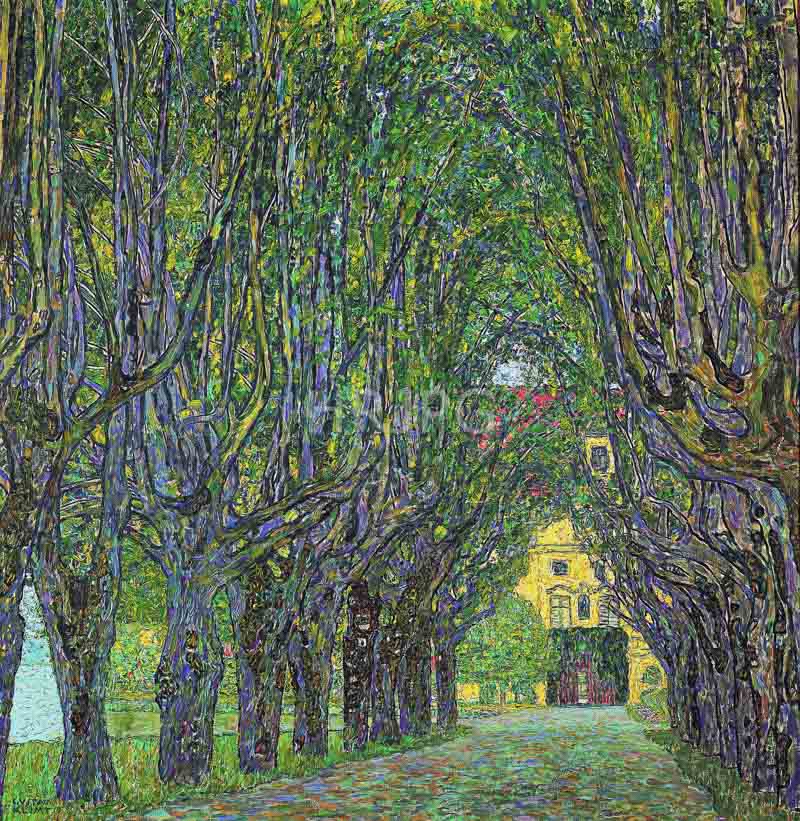
The vibrant oil landscape "Avenue in the Park of Schloss Kammer" was painted by Gustav Klimt in 1912. This work is a premier example of his mature "International Style" landscapes, produced during his summer retreats at Lake Attersee. During this period, Klimt moved away from the flat gold surfaces of his earlier career to explore a more "painterly" and atmospheric approach to nature. This painting captures the "immersive qualities" of a park avenue, transforming a simple natural path into a highly organized and rhythmic pattern of color and light, reflecting the Secessionist search for order and beauty within the natural world.
Technically, the composition is characterized by its "rhythmic brushstrokes" and the use of the square format. Klimt depicts an avenue of trees using a "compressed perspective" that brings the foreground and the distant trees into a single, shimmering plane. This technique was achieved by viewing the scene through a telescope, a practice that allowed him to flatten the space and emphasize the "mosaic of patterns" created by the foliage. He utilizes a rich palette dominated by varied greens, punctuated by dabs of yellow and white to capture the "shimmering light." The brushwork is rhythmic and textured, influenced by Neo-Impressionism, where each mark contributes to a vibrating surface that captures the movement of light through the leaves without relying on traditional perspective. The "avenue" creates a strong vertical anchor that guides the eye through the composition, while the lack of a traditional horizon line forces the viewer to focus on the surface beauty of the paint. This "all-over" approach transforms the natural scenery into a "decorative tapestry," illustrating his mastery in seeing the architectural structure within organic forms.
Historically, 1912 was a year of intense creative output and international recognition for Klimt. His Attersee landscapes were his most personal works, created for his own satisfaction. The focus on the park of Schloss Kammer reflects his close connection to the region and his interest in the "cultivated nature" of the estate gardens. This period in Vienna was marked by the "garden movement," which saw nature as a sanctuary of aesthetic renewal. The painting captures the spirit of "Modern Vienna," where the elite sought to find eternal beauty in the quietude of the countryside amidst the rapid changes of the modern city.
Art historians have consistently praised "Avenue in the Park of Schloss Kammer" for its "extraordinary atmospheric intensity." Critics such as Frank Whitford have noted the "tapestry-like" quality of the work, describing it as a "masterpiece of modern rhythm." The painting is praised for its "innovative synthesis" of Impressionist light and Secessionist design. Today, it remains one of the most sought-after works in his landscape repertoire, standing as a testament to his unrivaled ability to transform a simple natural observation into a profound and shimmering tapestry of life. It is regarded as a masterpiece of European Symbolism, celebrating the sacred and decorative within the natural world.