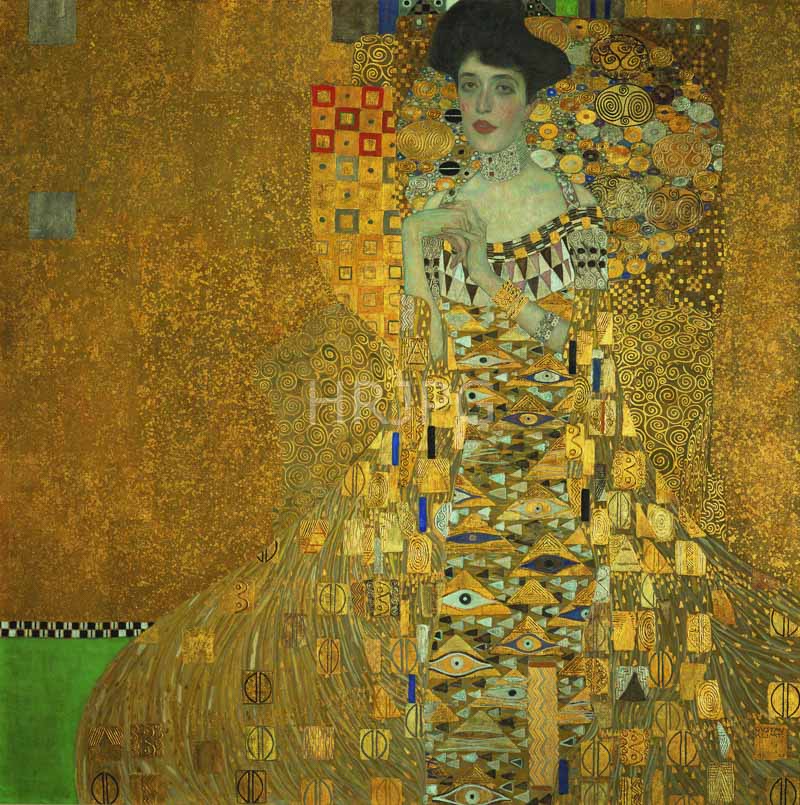
The iconic masterpiece "Portrait of Adele Bloch-Bauer I" (also known as "The Woman in Gold") was created by Gustav Klimt in 1907. This work represents the absolute zenith of his "Golden Phase" and is widely considered one of the most famous and culturally significant paintings in the world. Commissioned by the industrialist Ferdinand Bloch-Bauer, the portrait depicts his wife Adele, a prominent member of the Viennese Jewish elite and a close muse of the artist. The painting serves as a landmark of "Viennese Modernism," reflecting the era's pursuit of the Gesamtkunstwerk or total work of art, where the person, the ornament, and the environment are fused into a singular, shimmering aesthetic experience.
Technically, the composition is defined by its "radical synthesis of realistic portraiture and decorative abstraction." Adele’s face and hands are rendered with soft, three-dimensional modeling, capturing her refined features and intelligent gaze with extreme sensitivity. However, her body and the surrounding space are transformed into a dense, two-dimensional "mosaic of gold leaf" and intricate geometric patterns. Klimt utilizes a vast array of symbols—spirals, triangles, and stylized eyes—inspired by Egyptian art and the Byzantine mosaics of Ravenna. The "compressed perspective" pushes the subject to the very front of the picture plane, effectively turning the woman into a "secular icon" within a modern, golden shrine. The contrast between the luminous skin and the dark, metallic gold creates a visual vibration that heightens the painting’s sense of luxury and mystery. The original silver-coated frame, designed specifically for the work, further emphasizes the concept of the painting as a "precious object."
Historically, the painting is a testament to the "Creative Vienna" of the early 20th century. It reflects the close ties between the avant-garde artists and the progressive industrialist families who sustained them. Adele Bloch-Bauer was the only woman Klimt painted twice in full-length portraits, illustrating her unique status in his life. The painting also has a complex historical legacy involving its Nazi-era confiscation and its eventual restitution to the Bloch-Bauer heirs in 2006, a story that has turned the work into a universal symbol of justice and memory.
Art criticism has long identified "Adele Bloch-Bauer I" as the ultimate expression of the "Secessionist aesthetic." Critics such as Frank Whitford have noted the "overwhelming decorative intensity" of the work, describing it as a "symphony of gold." The painting is praised for its "psychological depth," as Adele’s calm, almost detached expression provides a point of stillness amidst the riotous ornamentation. Today, it is the centerpiece of the Neue Galerie in New York, standing as a testament to Klimt's unrivaled ability to transform a societal portrait into a timeless, shimmering mosaic of modern life and human dignity.