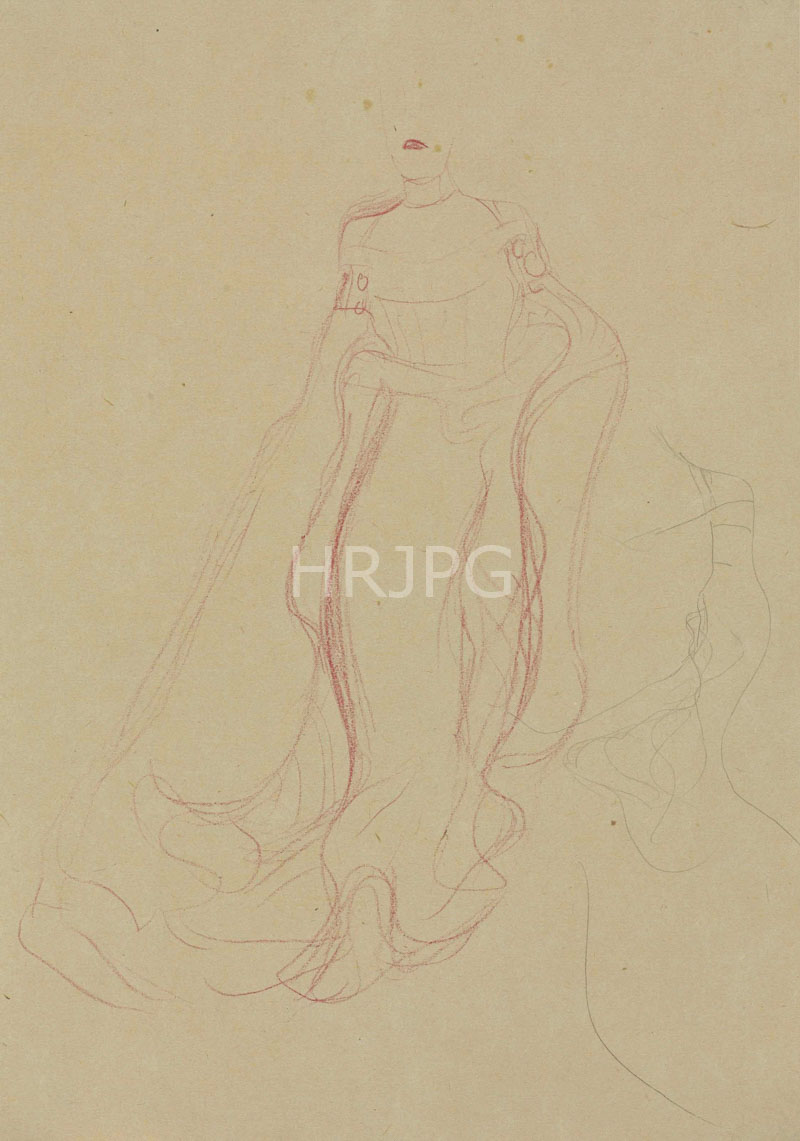
This refined and evocative graphite study, "Sitting Girl to the Right Study," was produced by Gustav Klimt in 1910. It belongs to his late mature period, a time when his graphic work moved away from the ornate decorative patterns of his "Golden Phase" toward a more raw, linear, and psychologically resonant aesthetic. This drawing is part of his prolific output of private figure studies, which he created daily as part of his studio practice. These drawings were essential to his development, serving as a laboratory for the "anatomical simplifications" and the exploration of character that would eventually inform his final oil paintings, reflecting the sophisticated intellectual climate of Vienna in the early 20th century.
Technically, the work is characterized by the use of "delicate and confident lines" to define the seated girl’s form. Klimt focuses his attention on her "relaxed posture" and the voluminous structure of her dress, turning the fabric into a primary expressive element. He utilizes a singular, continuous pencil line to define the contours, varying the pressure to suggest volume and the soft texture of skin without the need for traditional shading. There is a remarkable sense of "linear economy" here; the artist suggests the girl's individual character through the weight and direction of her pose. The "sitting to the right" orientation creates a sense of dynamic balance on the page, utilizing the negative space to enhance the subject’s "internal focus." The drawing reflects the influence of the younger Expressionist generation, who encouraged Klimt to find a more nervous and emotionally honest quality in his draftsmanship. This focus on "capturing the moment" prioritized psychological truth over academic perfection, making the figure appear both vulnerable and self-assured.
Historically, 1910 was a year of consolidation and international success for Klimt. His drawings from this period were highly sought after by collectors who appreciated their "unvarnished honesty." This study reflects the "Fin-de-Siècle" interest in the "inner life" of the subject, a theme influenced by the burgeoning field of psychoanalysis in Vienna. Klimt’s interest in the "unobserved pose" was part of a broader cultural movement toward a more realistic and personal representation of femininity, challenging the sanitized and idealized nudes of the academic tradition.
Art historians and critics have frequently praised these late studies for their "technical purity." Critics like Jane Kallir have noted that Klimt’s 1910 drawings show him at his most "sincere," revealing a deep empathy for his models. The study is praised for its "sophisticated simplicity," proving that Klimt could achieve a sense of monumental beauty through the most minimal means. Today, it remains a vital document for understanding the anatomical and decorative foundations of his late career, standing as a testament to his unrivaled ability to capture the "aura" of a person through the elegance of a single line.