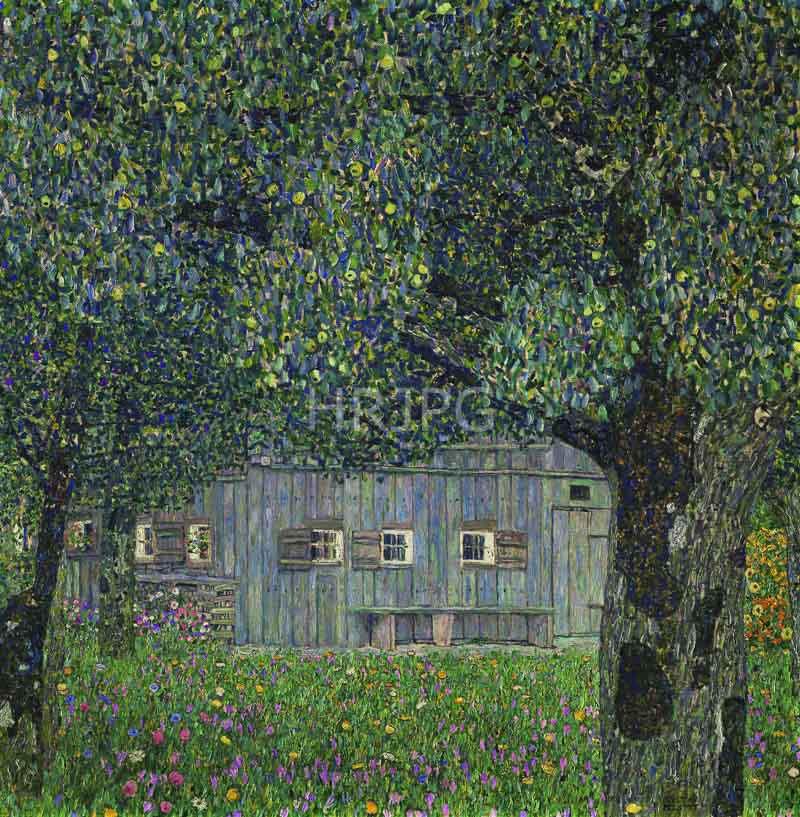
The vibrant and lush landscape "Farmhouse in Upper Austria" was painted by Gustav Klimt in 1911. This work belongs to his mature landscape period, produced during his annual summer retreats to Lake Attersee. By 1911, Klimt had moved away from the intense gold leaf of his middle years to explore what art historians call his "International Style," characterized by a more painterly, colorful, and expressive representation of nature. This painting captures the rhythmic beauty of the Austrian countryside, transforming a simple rustic farmhouse into a shimmering, decorative tapestry of color and light that reflects the artist's search for "total harmony" within the natural world.
Technically, the composition is a masterclass in the use of the "square format" and a "mosaic-like application of color." Klimt fills the entire canvas with a dense field of flowers and greenery, effectively eliminating any sense of middle ground or sky. This creates a "flattened decorative surface" that forces the viewer's eye to wander through the rhythmic dabs of paint. The farmhouse is nestled within this explosion of life, its architectural lines integrated into the overall ornamental pattern. Klimt utilizes a vibrant palette of emerald greens, oranges, and purples, applied with short, rhythmic brushstrokes influenced by Pointillism. The shimmering effect captures the play of light across the summer field without relying on traditional perspective. This "all-over" composition forces the eye to participate in the "sensory richness" of the scene, transforming a topographic view into a timeless, highly stylized work of art. The lack of human presence emphasizes the eternal, static beauty of the countryside, which was a hallmark of his late landscape style.
Historically, 1911 was a year of international recognition for Klimt, marked by his success at the International Art Exhibition in Rome. His summer landscapes were his most private works, created for his own satisfaction rather than for public commissions. The focus on the "Hortus Conclusus" (enclosed garden) reflects the "Fin-de-Siècle" search for refuge from the growing social and political instability of pre-war Europe. The work exemplifies the Secessionist ideal of the Gesamtkunstwerk, where every component of the scene—from a single petal to a stone wall—contributes to a unified, modern aesthetic experience.
Art criticism has long celebrated "Farmhouse in Upper Austria" for its "extraordinary atmospheric intensity." Critics such as Frank Whitford have noted the "tapestry-like" quality of the work, describing it as a "landscape of pure rhythm." The painting is praised for its "innovative design," prefiguring the later move toward total abstraction. Today, it remains a cornerstone of the Belvedere collection, standing as a testament to Klimt's unrivaled ability to see the extraordinary and sacred beauty within the density of a summer garden.