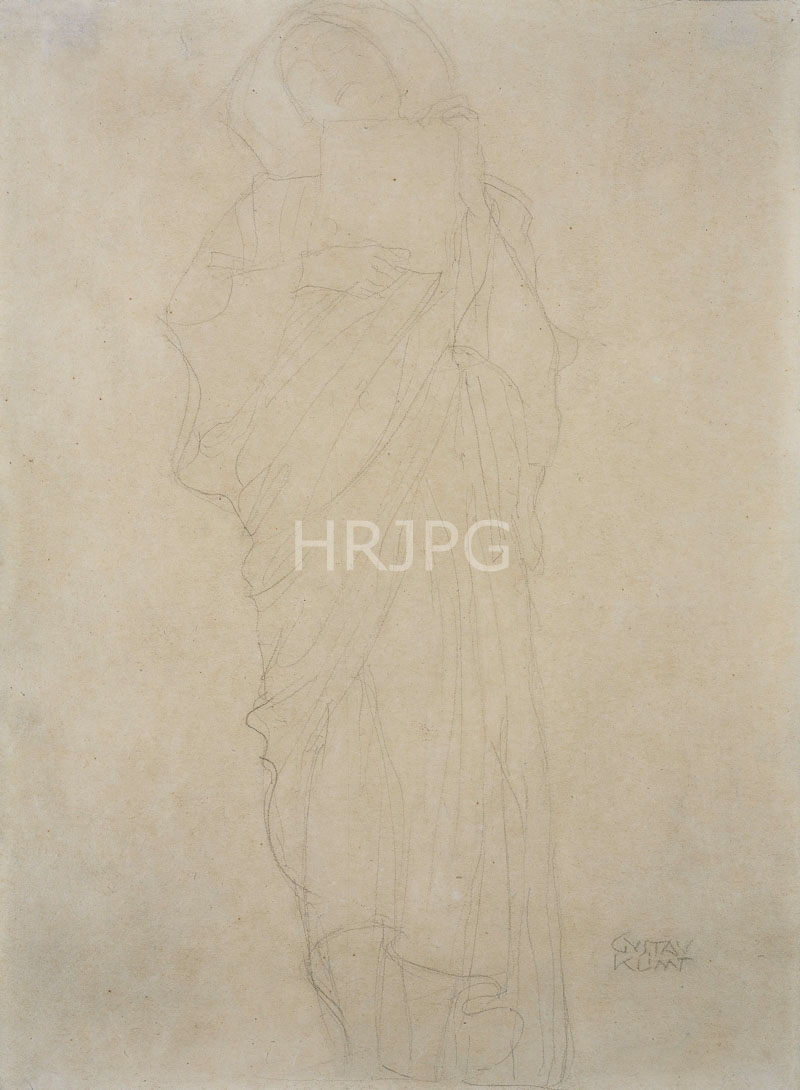
This powerful pencil drawing is a preparatory study for the figure of "Lex" (Law) in the monumental and highly controversial university painting "Jurisprudence," executed by Gustav Klimt around 1903. This was a time of extreme professional crisis for Klimt, as his "Faculty Paintings" commissioned for the University of Vienna were being rejected by the academic establishment for their radical Symbolist content. This study offers a rare glimpse into the graphic foundations of one of the most provocative projects in modern art history, where Klimt sought to redefine allegorical themes through a lens of psychological anxiety and raw human vulnerability.
Technically, the work is characterized by the "monumental weight" and "linear clarity" of the standing robed woman. Klimt utilizes a firm, rhythmic pencil line to define the silhouette, creating a figure that feels both grounded and ethereal. The robes are rendered with a focus on "architectural form," where the folds of the fabric create a vertical structure that dominates the page. Unlike the decorative grace of his earlier work, this study prioritizes "symbolic meaning" over ornamentation. The figure of Lex is presented with a somber, almost judgmental presence, reflecting the theme of law as a restrictive and overwhelming force. There is a notable anatomical simplification in the face and hands, which emphasizes the "aura of the archetype" rather than an individual personality. The use of negative space around the figure creates a sense of isolation and gravity, highlighting Klimt’s mastery of the "Secessionist line" as a carrier of profound emotional and philosophical weight.
Historically, "Jurisprudence" was a radical departure from traditional legal allegories. While the establishment expected a celebration of justice, Klimt presented a nightmare of punishment and human suffering. This study captures the "intellectual fermentation" of "Fin-de-Siècle" Vienna, where the works of Freud and the collapse of traditional morality were influencing every branch of art. It reflects a society grappling with the darker forces of the psyche, and the drawing serves as a crucial document of Klimt’s move toward a more "existential" modernism.
Art historians, including Christian Nebehay, have praised these university studies for their "unapologetic honesty." Critics note that the "Jurisprudence" drawings are often more revealing than the finished murals, as they show the artist's unvarnished struggle with the subject matter. The work is praised for its "monumental quietude," standing as a masterpiece of modern draftsmanship. Today, it is regarded as a vital reference for understanding the development of Symbolism in Austria and Klimt’s transition toward the more severe, linear aesthetic of his late period.