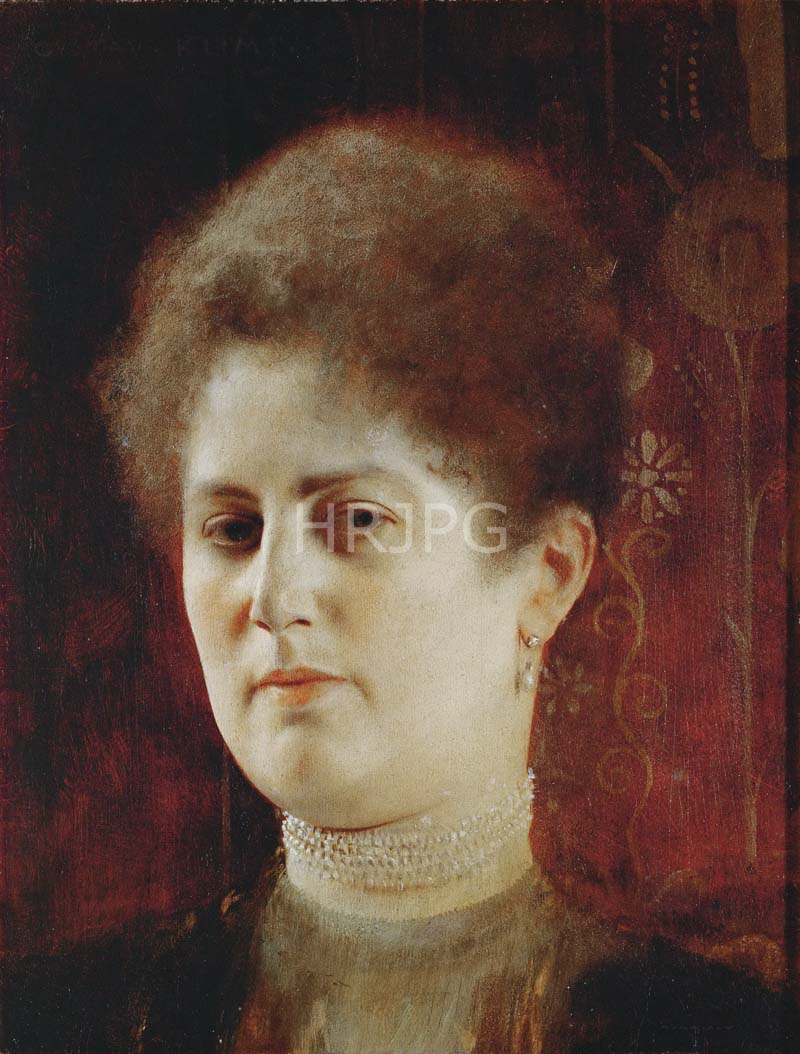
The refined oil portrait "Portrait of Frau Heymann" was created by Gustav Klimt in 1894. This work belongs to a pivotal transitional phase in Klimt’s career, occurring just a few years before the founding of the Vienna Secession. At this time, Klimt was established as a premier academic painter, yet this portrait reveals his growing dissatisfaction with purely descriptive realism. It marks the moment where his mastery of traditional techniques began to merge with a more personal, sensitive psychological depth, reflecting the burgeoning intellectual atmosphere of late 19th-century Austria.
Technically, the composition is defined by its "stately pose" and the dramatic use of a dark, atmospheric background. Klimt utilizes this somber environment to emphasize the subject's pale, luminous skin and her elegant, refined features. The lighting is focused and soft, characteristic of the "Mood Impressionism" that was gaining traction in Central Europe. While the lace and fabrics are rendered with academic precision, there is an emerging "sfumato" quality in the transitions, which imbues Frau Heymann with a sense of quietude and noble dignity. The focus is not merely on her social status, but on her internal state, captured through her steady, contemplative gaze. This approach to "modern portraiture" prioritizes the subject's aura over topographic detail, prefiguring the psychological intensity of his later mature works.
Historically, the 1890s were a period of intense societal change in Vienna. The Jewish upper-middle class, to which Frau Heymann belonged, were the primary patrons of the avant-garde, seeking portraits that reflected their sophisticated and progressive identities. This work captures the spirit of the "Ringstrasse era" while simultaneously looking toward the Symbolist movement. It demonstrates Klimt's ability to navigate the demands of high-society commissions while asserting his own evolving aesthetic priorities.
Art criticism has long identified this portrait as a masterpiece of Klimt’s early maturity. Critics such as Frank Whitford have noted the "Old Master" quality of the brushwork, comparing it to the works of Whistler and Velázquez. The painting is praised for its "unvarnished sincerity," proving that Klimt’s brilliance was rooted in a profound understanding of human sensitivity long before his "Golden Phase." Today, it remains a vital document for understanding his stylistic evolution, standing as a testament to his ability to capture the complex landscape of the human soul through the elegance of traditional oil painting.