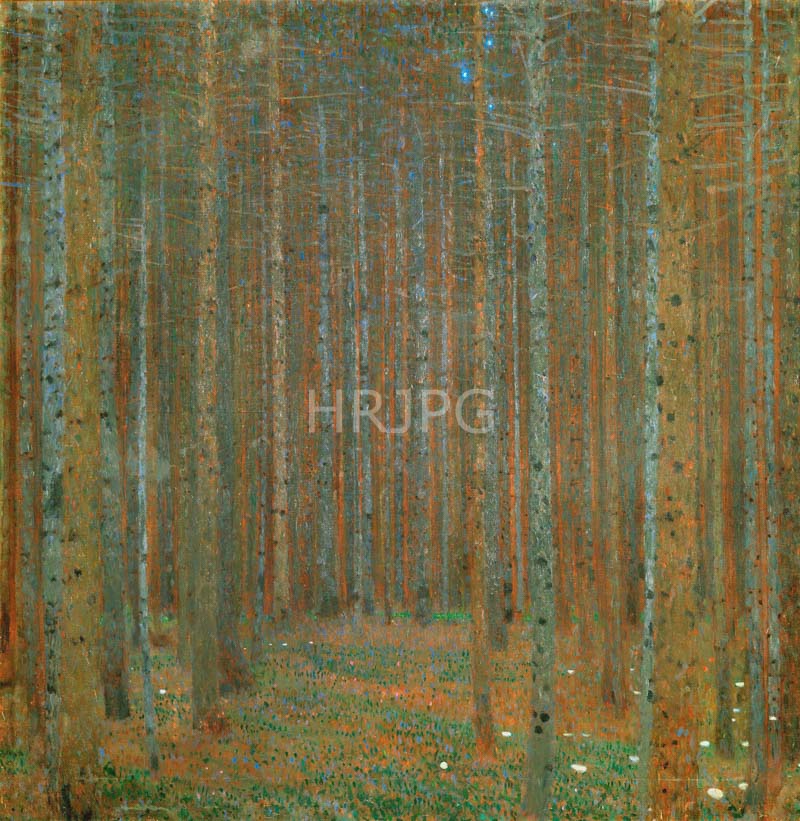
The enchanting oil landscape "Fir Forest I" was painted by the Austrian master Gustav Klimt in 1901. This work belongs to his early landscape period, a time when he was just beginning to establish his annual summer tradition of painting in the Austrian countryside. In 1901, Klimt was a leading figure of the Vienna Secession and was actively seeking a "new artistic path" that would allow him to escape the intense public controversies surrounding his "Faculty Paintings" in the city. "Fir Forest I" is a quintessential product of this escape, demonstrating his early innovative approach to the "immersive qualities" and the spiritual depth of nature.
Technically, the work is defined by its "radical verticality" and its lack of a traditional focal point. Klimt fills the entire square canvas with the dense, vertical trunks of a fir forest, effectively eliminating any sense of sky or distant horizon. This "all-over" composition—influenced by Japanese prints and Belgian Symbolism—creates a "flattened decorative space" that forces the viewer's eye to wander through the rhythmic repetition of the trees. The color palette is dominated by "cool tones" and earthy textures, using a range of deep greens, browns, and muted blues. Klimt utilizes thousands of small, mosaic-like brushstrokes to create a shimmering, textured surface that captures the "play of light" within the dense woods without relying on traditional linear perspective. This "mosaic effect" transforms the natural scene into a shimmering, decorative tapestry, where the individual trees become part of a larger, rhythmic whole. The composition is quiet and balanced, evoking a "serene atmosphere" that celebrates the decorative and spiritual qualities of the natural world. This approach prioritizes "mood and texture" over topographic detail, turning a simple forest interior into a sacred and highly organized sanctuary of beauty.
Historically, 1901 was a year of profound creative fermentation and public debate for Klimt. His summer retreats to the Attersee provided a necessary mental escape, allowing him to focus on the "tranquil rhythms" of nature. This painting reflects the "Fin-de-Siècle" obsession with the forest as a "secular cathedral," a place of spiritual renewal and aesthetic contemplation. The work reflects the influence of the "Scandinavians" and "Belgians" on the Secessionist aesthetic, particularly their focus on the poetic qualities of the landscape. It marks the birth of his "square format" landscapes, which he believed provided a more balanced and modern view of the world, free from the hierarchies of traditional landscape painting.
Art historians have long celebrated "Fir Forest I" for its "extraordinary atmospheric intensity" and its innovative synthesis of decorative grace and naturalistic observation. Critics such as Frank Whitford have noted the "obsessive observation" and the "ornamental harmony" of the work, describing it as a landscape that has been "filtered through a poetic lens." The painting is praised for its ability to capture a sense of "timeless stillness," a quality that is characteristic of his early nature studies. Modern scholars highlight the work as a crucial document of Klimt’s early landscape style, proving that his brilliance was rooted in his ability to see the sacred and decorative within the density of the natural world. Today, it remains a cornerstone for understanding the origins of his mature landscape style and his role as a pioneer of modern landscape painting.