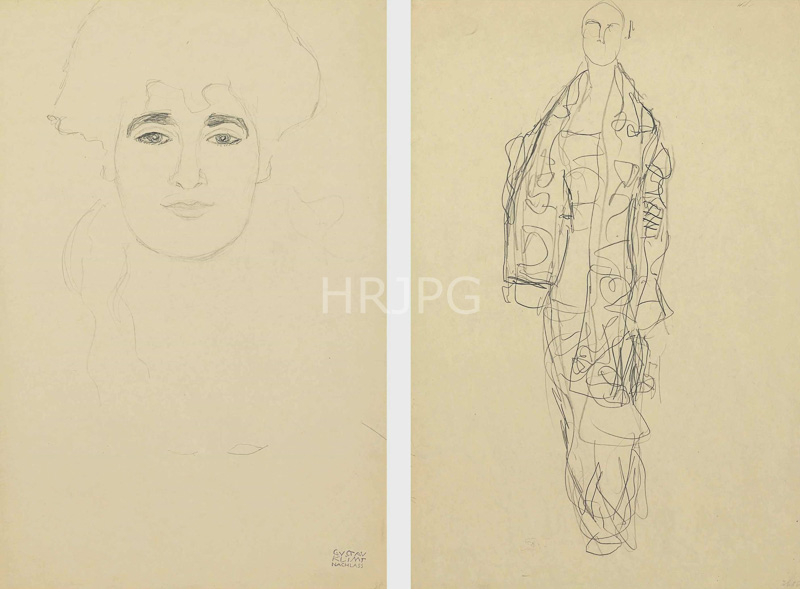
This elegant and sophisticated pencil drawing, "Study for Portrait of Amalie Zuckerkandl," was executed by Gustav Klimt between 1914 and 1916. It represents a significant moment in his late mature style, where he sought to balance the "psychological depth" of his subjects with the "decorative ornamentation" that had become his signature. Amalie Zuckerkandl was a prominent figure in the Viennese Jewish elite and part of a family that was among Klimt’s most significant late-period patrons. This drawing is part of a larger series of studies for a commissioned oil portrait that remained unfinished at the time of the artist's death, reflecting the close ties between the avant-garde and the progressive families of Vienna during the war years.
Technically, the work is characterized by the masterful "synthesis of the architectural textiles and the soft contours of the body." Klimt depicts Amalie wearing a kimono—a motif that reflects his lifelong fascination with Japanese art and fashion. He utilizes a delicate yet remarkably confident pencil line to define the woman's refined facial features and her dignified posture. The kimono is rendered as a complex field of "decorated patterns," where the rhythmic lines of the fabric create an architectural frame for the subject's personality. This juxtaposition is a key technical detail; the "static" patterns of the garment emphasize the "dynamic" and soft reality of the flesh. Shading is minimal, used only to suggest the softest transitions of light, while the "varying thickness of the line" conveys the texture of the garments and the firm reality of the skin. The composition is vertical and balanced, utilizing the white negative space of the paper to enhance the sense of the subject's "noble dignity." Klimt’s mastery lies in his "linear economy," where he captures the "aura" of a person through the elegance of a single line, creating a unified and modern aesthetic experience.
Historically, the Zuckerkandl family were central to the cultural and intellectual life of "Modern Vienna." Their salon was a hub for artistic activity, and Amalie was known for her intellect and support of the Secession. This study reflects the "Fin-de-Siècle" search for the Gesamtkunstwerk, where the portrait is integrated into a modern, aesthetic environment. The focus on Japanese fashion was part of the broader "Japonisme" movement, which sought a "universal aesthetic" that transcended national boundaries. The work captures the spirit of a city that saw fashion as a form of "living art" and a medium for artistic liberation.
Art historians have consistently praised these late portrait studies for their "technical purity" and "psychological gravity." Critics have noted that Klimt’s drawings from this period show his transition from a "virtuoso of realism" to a "master of modern characterization." The drawing is praised for its "sophisticated elegance," proving that Klimt could achieve a sense of monumental beauty through the most minimal graphic means. Today, it is regarded as a vital document for understanding the anatomical and decorative foundations of his late career, standing as a testament to his unrivaled ability to capture the "aura" of a person. It remains a moving and beautiful example of his search for the Gesamtkunstwerk within the human figure, bridging the gap between decorative tradition and modern psychological depth.