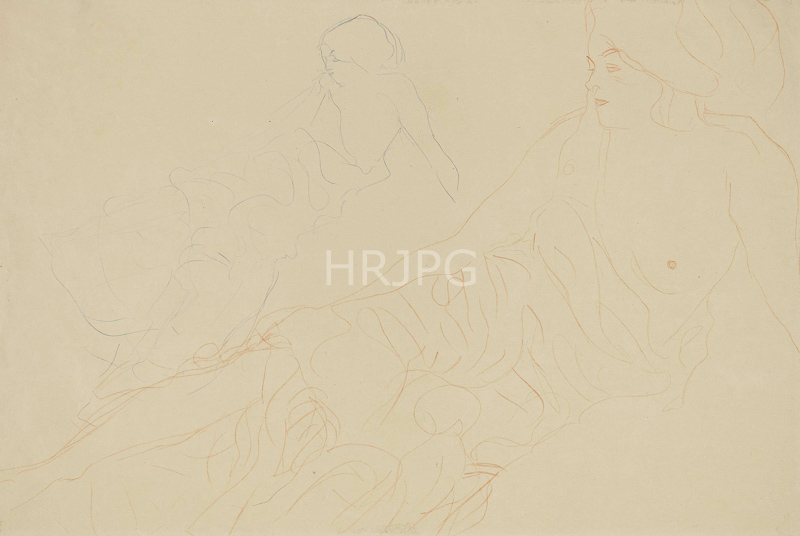
These two evocative graphite studies, titled "Two Studies of a Reclining Woman," were produced by the Austrian master Gustav Klimt in 1913. They belong to his late mature period, a time when his graphic work moved away from the ornate "Golden Phase" toward a more raw, linear, and psychologically charged aesthetic. During this stage, Klimt utilized drawing as a daily laboratory to explore the "expressive potential" of the human form in states of relaxation and internal focus. These studies were central to his artistic process, serving as a vital investigation for his more complex allegorical and decorative painted compositions, such as "The Bride" and "Leda."
Technically, the work is characterized by its "confident line work" and its focus on "anatomical simplification." Klimt depicts a reclining woman from two slightly different angles, capturing the "contorted poses" that emphasize the rhythmic curves of the body. He utilizes a singular, continuous pencil line to define the contours, varying the pressure of the lead to suggest volume and the soft texture of skin without the need for traditional shading. There is a remarkable sense of "psychological nuance" in these studies; the figures appear caught in a private, unobserved moment of quietude, reflecting the artist's focus on the "inner life" of his models. The use of negative space around the figures is strategic, creating a sense of weightlessness and ethereal beauty that highlights Klimt's ability to convey "monumental presence" through the most minimal graphic means. This approach reflects the influence of the younger Expressionist generation, who encouraged Klimt to find a more nervous and emotionally honest quality in his draftsmanship, prioritized over academic perfection.
Historically, 1913 was a year of international consolidation and intense creative output for Klimt. His drawings from this period were highly sought after by collectors who appreciated their "unvarnished honesty" and modern sensibility. This period in Vienna was marked by the "sexual revolution" in intellectual life, influenced by the burgeoning field of psychoanalysis. Klimt’s interest in the "unobserved nude" was part of a broader cultural movement toward the liberation of the body from Victorian social and artistic restrictions. These private drawings were essential to his development, acting as the foundation for the anatomical truth that underpinned his most famous and controversial late works.
Art historians and critics have frequently praised these late studies for their "technical purity" and "psychological gravity." Critics like Christian Nebehay have argued that Klimt’s drawings from 1913 show his transition from a "virtuoso of realism" to a "master of modern characterization." The studies are praised for their "sophisticated simplicity," proving that Klimt could achieve a sense of monumental beauty through the simplest tools. Today, "Two Studies of a Reclining Woman" is regarded as a vital reference for understanding the development of modern figurative art and the shift from Art Nouveau's decorative grace to the raw emotionality of Expressionism. It stands as a testament to his unrivaled ability to see and represent the extraordinary grace within the simplest, most intimate human form.