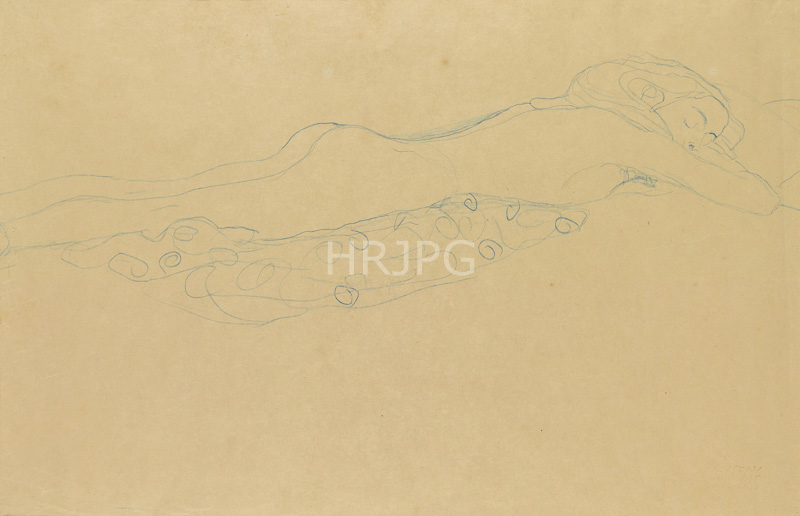
This exquisite and sensual graphite study was produced by Gustav Klimt in 1907, during the absolute height of his "Golden Phase." It serves as a vital preparatory work for his large-scale allegorical painting titled "Water Serpents II," which explored the themes of feminine eroticism and the "ethereal underwater world." By 1907, Klimt had established himself as the leading artist of the Vienna Secession, and his drawings from this period were highly sought after for their "technical refinement" and their daring exploration of intimacy. This study represents a significant moment in his search for a "modern graphic language" that could convey the fluid beauty of the human form through a sophisticated, decorative lens.
Technically, the work is characterized by its "rhythmic and flowing lines" that define both the reclining female nude and her cascading hair. Klimt utilizes long, sweeping strokes of the pencil to trace the contours of the figure, creating a sense of "weightless suspension" that is central to the underwater theme. The hair is treated as a primary decorative element, rendered as a swirling mass of lines that merge with the silhouette of the body. There is a remarkable sense of "linear elegance" and anatomical grace; Klimt focuses on the "vibration of the contour" rather than heavy shading, allowing the white space of the paper to act as a luminous environment. This approach was heavily influenced by "Japonisme" and the Byzantine mosaics, which encouraged him to see the surface as a carrier of symbolic meaning. The pose is one of "languid surrender," capturing the sensuality and mystery that defined the peak aesthetic of the Secession era. Klimt’s mastery lies in his ability to "map the body" as a series of rhythmic patterns, transforming a biological reality into a highly stylized and modern work of graphic art.
Historically, "Water Serpents II" project reflects the intellectual and cultural climate of "Fin-de-Siècle" Vienna, a city deeply preoccupied with the mysteries of the psyche and the complexities of desire. Influenced by the works of Sigmund Freud, Klimt sought to represent the "unconscious mind"—a place of fluid identities and primal urges. This was a period when the "feminine archetype" was being reinterpreted as a symbol of power and autonomous sensuality. These private drawings were essential to his creative process, serving as a laboratory for the formal experiments that would appear in his most famous golden canvases.
Art historians and critics have frequently praised these "Water Serpent" studies for their "extraordinary graphic refinement." Critics like Alessandra Comini have noted that Klimt’s drawings are often "more revealing than his finished paintings," showing the raw nerve of his artistic intent. The study is praised for its "melodic line" and its ability to convey a sense of monumental beauty through the most minimal means. Today, it remains a vital document for understanding the anatomical and decorative foundations of his mature style, standing as a testament to his unrivaled ability to capture the "aura" of a person through the elegance of a single line. It is regarded as a masterpiece of modern draftsmanship, proving that Klimt remained a pioneer in the artistic exploration of the body and desire.