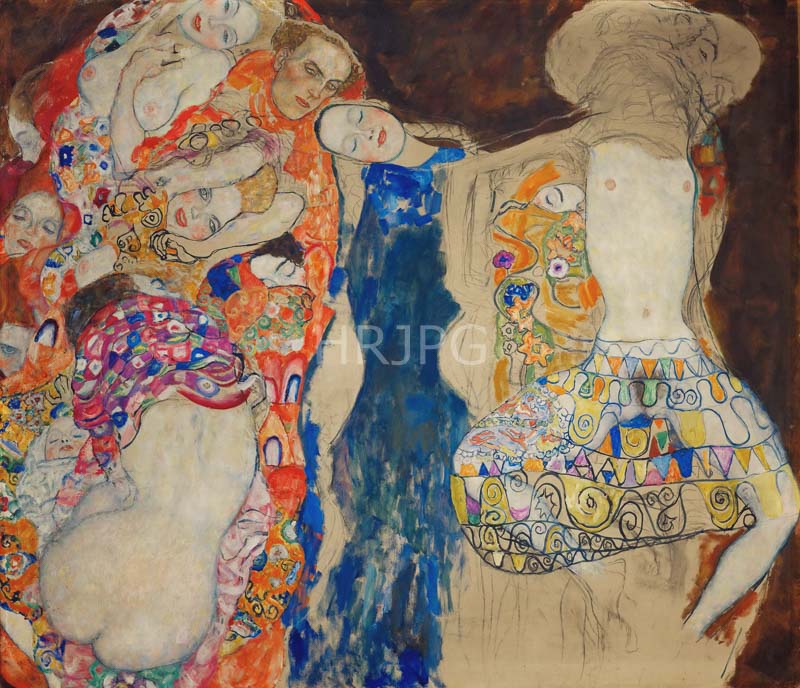
The monumental and hauntingly beautiful oil painting titled "The Bride" was executed by Gustav Klimt between 1917 and 1918, remaining unfinished at the time of his death. This work is one of his final major masterpieces, representing the absolute culmination of his late mature style, often referred to as his "International Style." During these years, Klimt moved away from the rigid gold surfaces of his earlier work to embrace a more "painterly" and color-focused aesthetic. "The Bride" is a profound and complex allegory of the "female lifecycle," depicting a central figure surrounded by a swirling mosaic of humanity, exploring themes of desire, love, and the eternal "cycle of life" that transcends individual existence.
Technically, the composition is characterized by its "swirling circularity" and its extraordinary use of vibrant, expressive color. The central bride is shown in a state of dreamlike suspension, while a group of intertwined female figures—representing different stages of life and emotional experience—swirls around her in a dynamic, cloud-like formation. Klimt utilizes a large, horizontal format to create an "immersive decorative space." The palette is a riot of pinks, purples, oranges, and deep blues, applied with a rhythmic, "shimmering" technique that creates a sense of "physical vibration." Because the work is "unfinished," we can see the raw charcoal underdrawing and the initial washes of color, which provides a unique insight into his creative process. Klimt’s mastery of "anatomical simplification" is evident in the way the bodies merge and flow into one another, suggesting a loss of individual identity in the face of universal forces. The "flattened decorative surface" is filled with intricate floral and geometric motifs, which unify the diverse figures into a single "tapestry of life." The lack of a traditional background pushes the figures to the very front of the picture plane, creating an "optical experience" that captures the ephemeral and dreamlike nature of human existence.
Historically, 1917 and 1918 were years of profound tragedy and change in Vienna, marked by the end of the Great War and the collapse of the Austro-Hungarian Empire. "The Bride" reflects the "somber, reflective mood" of that era, as Klimt retreated into the private world of his studio to explore universal human themes. The painting was influenced by the burgeoning field of psychoanalysis and the philosophical writings of Schopenhauer, who saw existence as a "will" to life. It captures the spirit of a city that was simultaneously obsessed with beauty and decay, representing the "Fin-de-Siècle" move toward a more subjective and symbolic representation of reality.
Art criticism has long identified "The Bride" as one of the most successful syntheses of "decorative design and emotional depth" in modern art. Critics such as Frank Whitford have noted the "swirling energy" of the work, describing it as a "masterpiece of modern Symbolism." The painting is praised for its "unvarnished sincerity" and its ability to convey profound existential anxiety through a sophisticated visual language. Today, it remains a centerpiece of the Belvedere collection in Vienna, standing as a testament to Klimt's unrivaled ability to transform a complex philosophical allegory into a shimmering, eternal mosaic of human life. It is regarded as a poignant and powerful conclusion to the career of one of the most influential artists of the modern era.