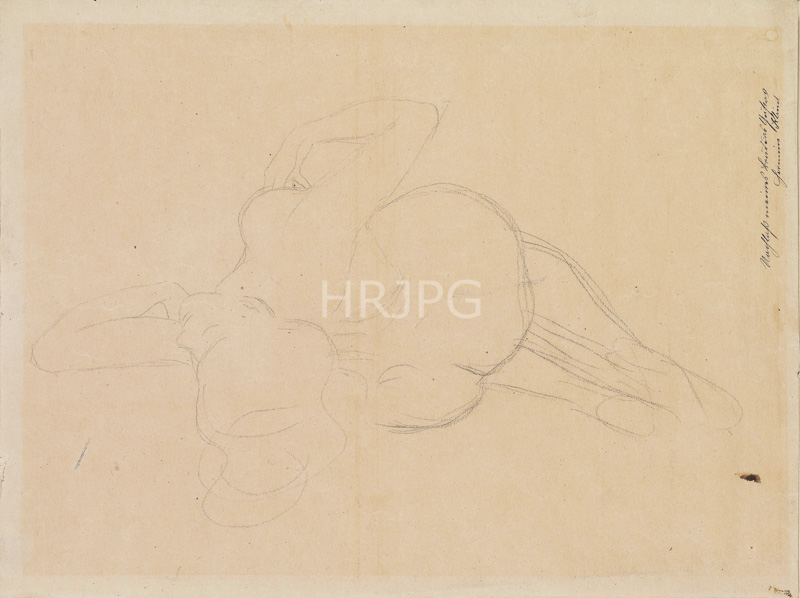
This delicate and evocative pencil drawing, titled "Seated Woman," was executed by Gustav Klimt approximately between 1912 and 1913. It belongs to his mature graphic period, a time when the artist retreated from the monumental, gold-laden paintings of his middle career to focus on the raw, psychological potential of the human form within his private studio practice. Klimt’s studio was a sanctuary where he could observe his models in unposed, natural states, allowing him to capture the "truth" of the female body beyond the constraints of social decorum or academic rigidness. This work is a testament to the "linear economy" and the intimate sensuality that defined his late style.
Technically, the drawing is characterized by its "mastery of fluid and sensitive line work." Klimt captures the seated woman in a pose where she leans backward, her head resting on her knees, creating a sense of "quiet introspection" and vulnerability. He utilizes a singular, continuous pencil line to define the contours of the body, varying the pressure of the lead to suggest volume and the soft texture of skin. There is almost no cross-hatching or heavy shading; instead, the artist relies on the "rhythm of the line" to convey the physical and emotional weight of the subject. The composition is compact and focused, utilizing the white negative space of the paper as a luminous field that emphasizes the figure's "weightless suspension." This "anatomical grace" is achieved through a process of simplification, where the gesture itself becomes the primary expressive element. The drawing reflects the influence of the "Japanese line" and the emerging Expressionist movement, where the artist’s subjective reaction to the model is prioritized over objective anatomical accuracy.
Historically, these late figure studies reflect the changing moral and intellectual climate of pre-war Vienna. Influenced by the radical ideas of Sigmund Freud and Arthur Schnitzler, Klimt sought to represent the "unconscious life" and the private moments of his subjects. While his public portraits were often highly idealized, his drawings were a sanctuary of "erotic and psychological honesty." This period saw Klimt moving toward a more "human" and less "iconic" representation of women, reflecting his personal relationships and the broader cultural shift toward modernism. These works were essential to his development, serving as a laboratory for the formal experiments that would appear in his final, unfinished paintings.
Art historians and critics have long identified Klimt’s late drawings as some of the most innovative and important graphic works of the early 20th century. Critics like Jane Kallir have argued that these works show Klimt at his most "authentic," revealing a deep empathy for his models. "Seated Woman" is praised for its "sophisticated simplicity" and its ability to convey a sense of monumental beauty through the most minimal graphic means. Today, it is regarded as a cornerstone of modern figurative art, demonstrating the shift from the idealized academic nude to the psychological and expressive honesty of the 20th century. The work remains a moving and powerful testament to Klimt's unrivaled ability to capture the complex, intimate, and sacred landscape of the human spirit through a single, elegant line.