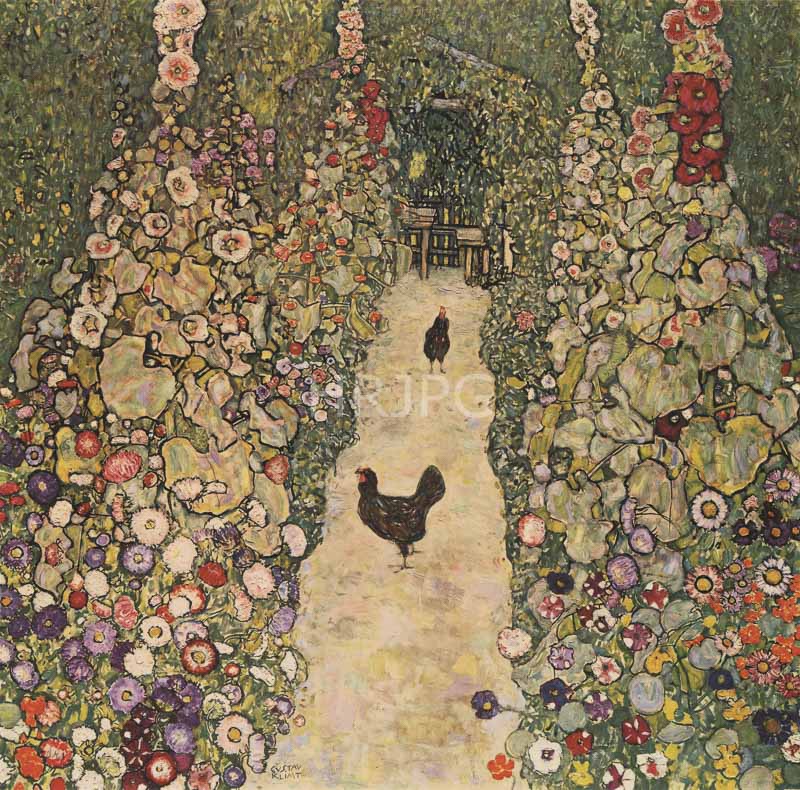
The vibrant and charming oil landscape "Garden Path with Chickens" was painted by the Austrian master Gustav Klimt in 1916. This work belongs to his final mature period, produced during his summer retreats to the Attersee region. At this stage in his career, Klimt had moved away from the intense gold-leaf ornamentation of his middle years to explore a more "painterly" and atmospheric representation of the natural world. This painting captures the essence of a rustic garden, transforming a simple domestic scene into a shimmering, decorative tapestry that reflects the artist's search for tranquility and modern order within the Austrian countryside in summer.
Technically, the composition is a masterclass in the use of a "high horizon line" and dense, mosaic-like patterning. Klimt fills the square canvas with a lush arrangement of flowers and greenery, effectively eliminating any traditional sense of sky or distant perspective. This forces the viewer's eye to wander through the rhythmic brushstrokes that define the garden path. The color palette is extraordinarily rich, featuring a symphony of greens, yellows, and vibrant floral reds and purples. Klimt utilizes a pointillist technique where thousands of tiny dabs of paint create a shimmering effect, capturing the play of light across the foliage without relying on realistic three-dimensional modeling. The "chickens" of the title are rendered as small, almost abstract accents of color, adding a touch of rustic life that is integrated into the overall decorative scheme. This "all-over" composition—influenced by Japanese prints and Byzantine mosaics—unifies the diverse natural elements into a single, shimmering work of art.
Historically, 1916 was a year of profound personal and political transition for Klimt, marked by the ongoing tragedy of World War I. His retreats to the Attersee provided a necessary mental escape from the social and political collapse of the Austro-Hungarian Empire. This work reflects the "Fin-de-Siècle" obsession with the garden as a "Hortus Conclusus" (enclosed garden), a sanctuary of beauty and order amidst the growing complexities of urban and political life. The painting captures the spirit of "Modern Vienna," where the elite sought refuge in the permanence of nature.
Art criticism has long celebrated "Garden Path with Chickens" for its "extraordinary atmospheric quality" and its innovative synthesis of decorative grace and naturalistic observation. Critics such as Frank Whitford have noted that Klimt’s late landscapes are "purely optical experiences," where the eye is invited to participate in the vibration of color. The painting is praised for its "meditative stillness," a quality that distinguishes Klimt from the more chaotic energy of contemporary Expressionists. Modern scholars highlight the work as a masterpiece of early 20th-century Symbolism, noting its profound influence on the later developments of modern decorative art. Today, it remains a cornerstone for understanding the evolution of his late landscape style, standing as a testament to his ability to see the extraordinary and sacred beauty within the simplest rustic scene.