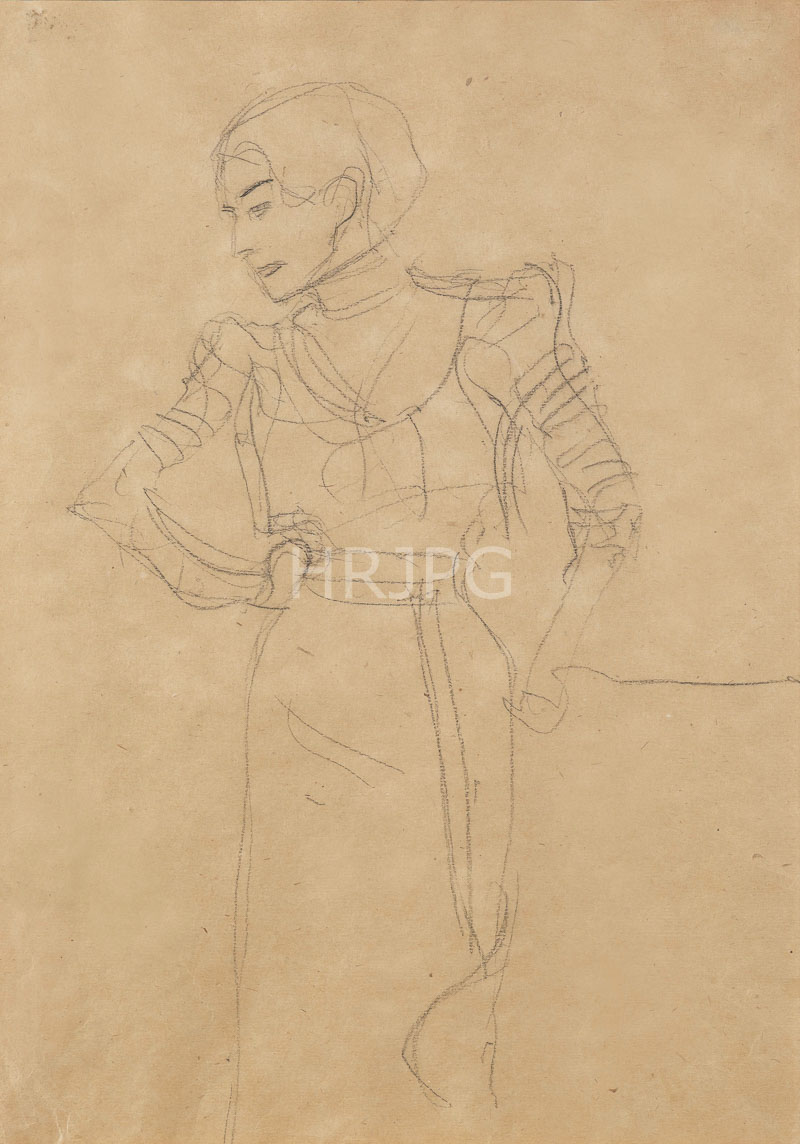
The bold and expressive pencil study "Portrait of Eugenia Primavesi" was executed by Gustav Klimt in 1913. It belongs to his late mature period, a stage in his career where his graphic work achieved a perfect "fusion of anatomical clarity and ornamental splendor." Eugenia Primavesi, along with her industrialist husband Otto, was one of Klimt’s most significant late-period patrons and a central figure in the survival of the Wiener Werkstätte. This drawing is a premier example of his search for a "modern portrait style" that could convey both the "social authority" and the vibrant personality of the subject, reflecting the "International Style" that would define his final years before the Great War.
Technically, the work is characterized by its "bold structural lines" and its meticulous planning of the decorative motifs. Klimt captures Eugenia in a "confident, full-length posture," utilizing a remarkably firm and rhythmic pencil line to define the volume and movement of her body. There is a sense of "monumental weight" in the pose, which Klimt balances with the "linear elegance" of the face and hands. A key technical detail is the placement of the "decorative motifs" on her dress—stylized birds and floral patterns—which are rendered as a dense mosaic of lines. This juxtaposition is essential; the "anatomical clarity" of the body serves as a framework for the "ornamental splendor" of the textiles. Klimt utilizes a "compressed perspective" and a vertical format to push the figure forward, creating a strong sense of psychological presence. Shading is minimal, used only to suggest the softest transitions of light, while the "varying thickness of the line" conveys the texture of the garments and the firm reality of the skin. This approach illustrates his mastery of "linear portraiture," where the ornament is not an addition but an organic part of the subject’s "aura" and social world.
Historically, 1913 was a year of international success and creative consolidation for Klimt. The Primavesi family’s estate in Moravia was a hub for artistic activity, and Klimt’s portraits of the family are some of his most sincere and vibrant works. This study reflects the "Fin-de-Siècle" search for the Gesamtkunstwerk, where the portrait is integrated into a modern, aesthetic environment. The work captures the spirit of "Modern Vienna"—a culture that sought to define its progressive identity through the radical synthesis of beauty and personality. It demonstrates how Klimt moved away from the "Golden Phase" icons to a more "human-centered" and expressive modernism.
Art criticism of the late 20th century has frequently highlighted the "sophisticated design" of Klimt’s late portrait studies. Critics like Jane Kallir have noted that these works show Klimt at his most "sincere," revealing a deep empathy for his patrons. The study is praised for its "graphic power" and its ability to convey a sense of "stately dignity" through the most minimal means. Today, it is regarded as a masterpiece of modern draftsmanship, standing as a testament to Klimt's unrivaled ability to capture the "presence" of a person through the elegance and architectural strength of a single line. It remains a vital reference for understanding the anatomical and decorative foundations of his final, vibrant masterpieces. It is a powerful reminder of the enduring creative energy of a city on the verge of profound change.