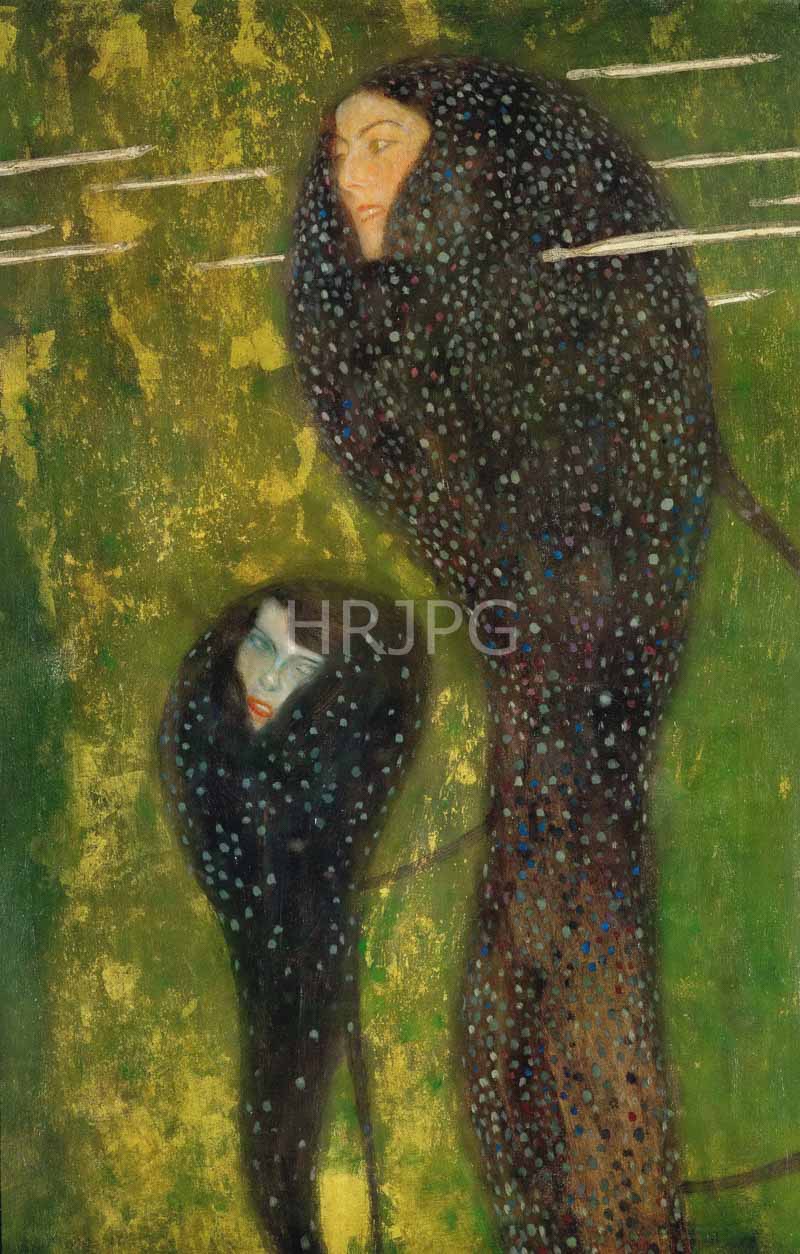
The symbolic and hauntingly beautiful oil painting "Nymphs" (also known as "Silver Fish") was created by Gustav Klimt in 1899. This work is a seminal product of his early Vienna Secession period, representing a daring move into the realm of "erotic Symbolism" and the "modern mythological" gaze. During this time, Klimt was increasingly fascinated by the idea of an "ethereal underwater world," where the boundary between human and nature dissolves. The painting explores themes of mystery, desire, and the "dangerous allure" of the female form, reflecting the "Fin-de-Siècle" obsession with the siren and the nymph as symbols of the untamable and subconscious forces of the psyche.
Technically, the composition is defined by its "radical verticality" and its extraordinary use of shimmering textures. Klimt depicts two ethereal nymphs floating in a dark, greenish underwater void, their elongated forms rendered with soft, fluid modeling. He utilizes a "compressed perspective" and a high horizon line, pushing the figures to the very front of the picture plane and creating a sense of "voyeuristic intimacy." The "silver fish" of the title appear as shimmering, jewel-like accents that swirl around the nymphs, adding to the work’s sense of "decorative mystery." The color palette is dominated by deep greens, blues, and silvers, applied with rhythmic, mosaic-like brushstrokes that capture the "play of light" through water. This approach prioritizes "atmosphere and mood" over traditional three-dimensional depth, transforming a mythological scene into a modern, decorative tapestry. The "flattened surface" and the "undulating lines" of the nymphs' hair reflect the influence of both Japanese prints and the Belgian Symbolists, such as Jan Toorop. This technique creates a visual vibration that heightens the painting’s sense of "eroticism and power," where the figures seem both vulnerable and profoundly autonomous.
Historically, 1899 was a year of profound creative output and public controversy for Klimt. His "Faculty Paintings" for the University of Vienna were already under fire, and "Silver Fish" represents his "unapologetic commitment" to a more radical and personal artistic vision. This period in Vienna was marked by the birth of psychoanalysis, and Klimt’s underwater scenes act as perfect metaphors for the "unconscious mind"—a place of fluid identities and primal desires. The work reflects the "sexual revolution" in Viennese intellectual life, where the traditional nude was replaced by a more "psychologically charged" representation of femininity.
Art historians have long celebrated "Silver Fish" for its "extraordinary decorative intensity" and its "Symbolist depth." Critics such as Frank Whitford have noted the "shimmering, jeweled surface" of the painting, describing it as a "masterpiece of modern eroticism." The painting is praised for its "innovative synthesis" of nature and myth, proving that Klimt could achieve a sense of monumental beauty through a highly stylized and "ethereal" visual language. Today, it remains a cornerstone of major collections, standing as a testament to Klimt's unrivaled ability to transform a mythological theme into a shimmering, eternal mosaic of desire and mystery. It is regarded as a landmark in the evolution of modern Art Nouveau.