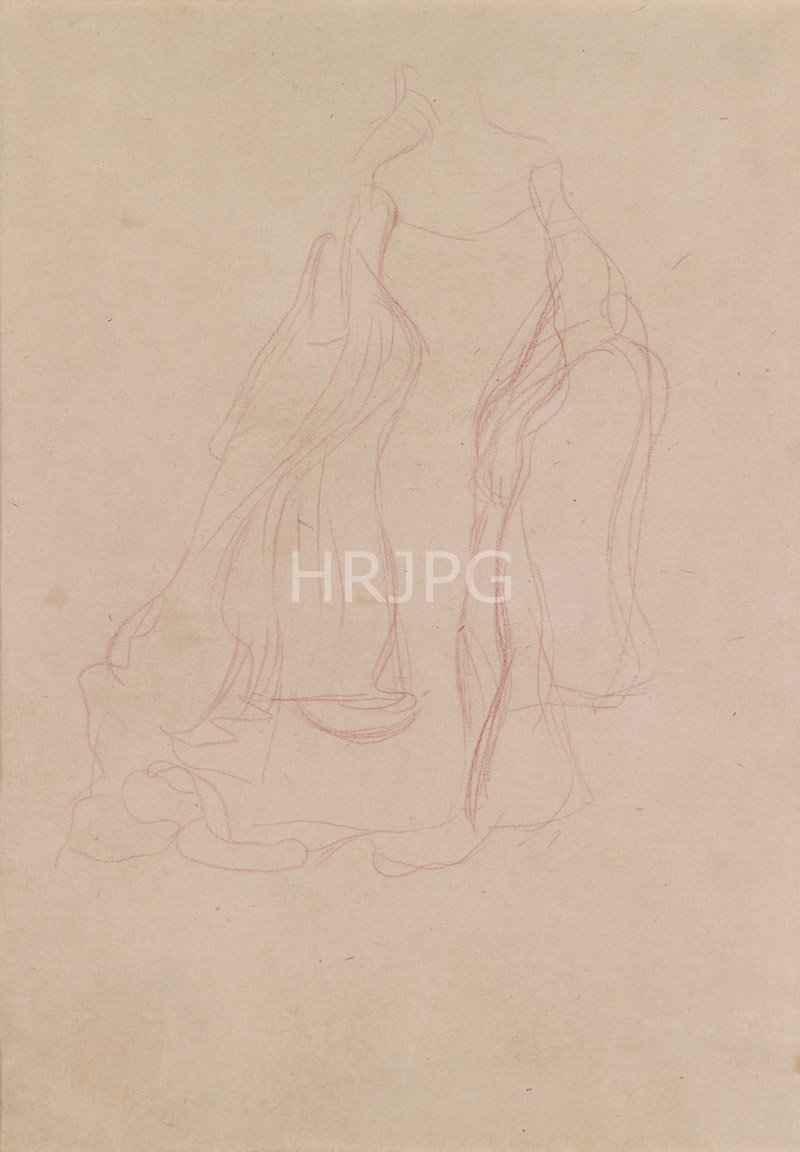
The spontaneous and highly rhythmic "Costume Study" was executed by Gustav Klimt around 1900. Produced during the early, radical years of the Vienna Secession, this work is a fascinating example of Klimt’s interest in the "synthesis of human form and ornamental design." Throughout his career, Klimt was deeply involved in the world of fashion and theater, often collaborating with his companion Emilie Flöge on the revolutionary "Reform Dress" movement. This study was likely intended for a larger allegorical or theatrical project—perhaps a mural or a costume design—reflecting the Secessionist goal of the Gesamtkunstwerk or total work of art, where every element of a visual environment is harmoniously organized.
Technically, the work is a masterclass in the use of "chalk and gestural lines" to define the flow of fabric. Klimt utilizes a series of rhythmic, swirling strokes to capture the "architectural and decorative details" of a garment, showing how the cloth moves and drapes around an invisible figure. The focus is entirely on the "interplay of lines" and the internal logic of the ornament, rather than on anatomical realism. There is a sense of "dynamic energy" in the chalk marks, varying in thickness and pressure to suggest the weight and texture of the material. This "linear economy" allows the artist to explore the "decorative potential" of the costume as a primary expressive element. The use of negative space is strategic, allowing the "rhythmic flow" of the fabric to dominate the page. This approach highlights Klimt's search for an "essentialist" graphic language, where the "pattern" itself becomes a carrier of symbolic meaning, reflecting his transition toward the dense, jewel-like ornamentation of his mature style. The sketch possesses a "modern spontaneity" that anticipates the developments of early 20th-century fashion illustration and abstract design.
From a historical perspective, 1900 was a year of intense creative fermentation in Vienna. The "Reform Dress" movement sought to liberate the body from the restrictive corsetry of the 19th century, a mission that mirrored the Secession's desire to liberate art from academic tradition. This costume study reflects that "liberation," focusing on a garment that is both functional and highly expressive. The work reflects the influence of "Japonisme" and the "Symbolists" on the Viennese avant-garde, particularly their focus on the "shimmering surface" and the decorative unity of the world. It captures the spirit of a city that saw fashion as a form of "living art."
Art criticism has long identified these "costume studies" as vital keys to understanding Klimt’s aesthetic philosophy. Critics such as Jane Kallir have noted that Klimt’s interest in textiles was not superficial but was a profound exploration of "the geometry of beauty." The study is praised for its "melodic line" and its ability to convey a sense of "monumental grace" through a fleeting sketch. Today, it remains a vital reference for the study of modern design history, standing as a testament to Klimt's unrivaled ability to see the extraordinary beauty within the "architectural flow" of a simple garment. It proves that his genius was rooted in the seamless fusion of form and ornament.