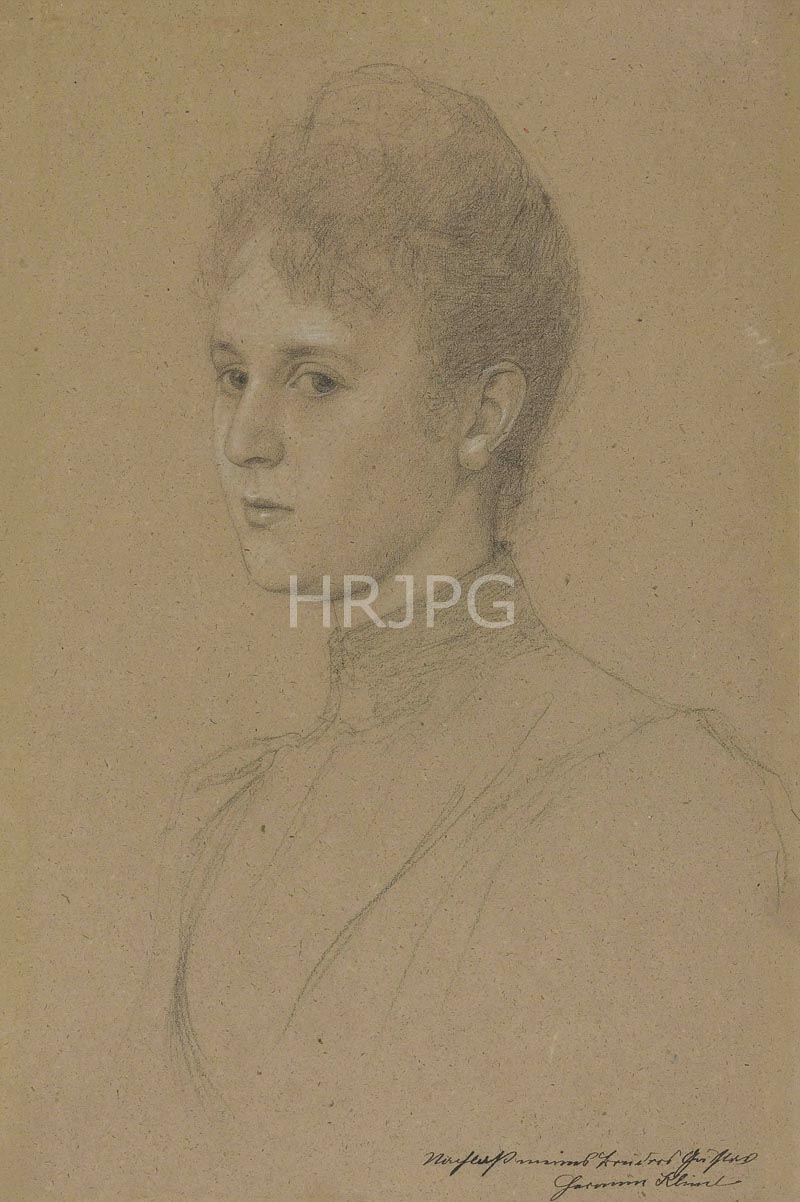
This refined pencil and graphite drawing, "Study for a Portrait Mrs. Heymann," was executed by Gustav Klimt around 1892. It belongs to the "middle period" of his career—the years between his early academic success and the founding of the Vienna Secession. This was a time of profound artistic transition, as Klimt began to move away from the "Historical Realism" of Hans Makart toward a more sensitive, psychological, and modern approach to portraiture. The work serves as a crucial record of his search for "noble dignity" and individual characterization, reflecting the shifting aesthetic desires of the Viennese Jewish upper-middle class during the late 19th century.
Technically, the work is defined by its "soft transitions" and precise anatomical modeling. Klimt captures Mrs. Heymann in a moment of quiet thought, her thoughtful expression rendered with extreme sensitivity to the nuances of bone structure and skin. He utilizes a range of "smudged graphite" and fine lines to suggest shadow and depth, creating a sense of three-dimensional presence that is both solid and ethereal. The composition is vertical and balanced, focusing on the subject’s head and elegant bearing. There is a specific focus on the "textures of the garments" and the way they frame the face, an early hint of the decorative obsession that would later define his mature style. Unlike the sharp, clear contours of his earlier murals, this study features a more "atmospheric" and painterly line, influenced by the international Symbolist movement. This "precise modeling" allows the artist to imbue the subject with a sense of psychological depth, moving beyond the external "status" of the sitter to explore her internal world. The use of the paper’s natural tone as a mid-ground allows the highlights to breathe, adding to the work's sense of "luminous dignity."
Historically, 1892 was a year of profound change in Vienna, marked by the death of Klimt’s father and brother, which led to a period of deep depression and artistic withdrawal. This drawing reflects the "somber and reflective mood" of that era. Mrs. Heymann was part of the progressive social circles that would eventually support the Secession. This work reflects the "Fin-de-Siècle" move toward a more subjective representation of reality, where the "aura" of the subject became more important than the literal topographic recording of her features. It captures the spirit of a society that was beginning to look inward, searching for meaning in the complexities of the human psyche.
Art historians have consistently praised this study for its "technical sophistication" and "emotional honesty." Critics have noted the "Old Master" quality of the drawing, comparing Klimt’s handling of the subject to the works of Ingres. The study is celebrated for its "sophisticated simplicity," proving that even before the "Golden Phase," Klimt was a master of modern characterization. Today, it remains a vital document for understanding his stylistic evolution, standing as a testament to his ability to see and represent the extraordinary grace within a quiet, domestic presence. It is regarded as a masterpiece of transition, bridging the gap between the 19th and 20th centuries.