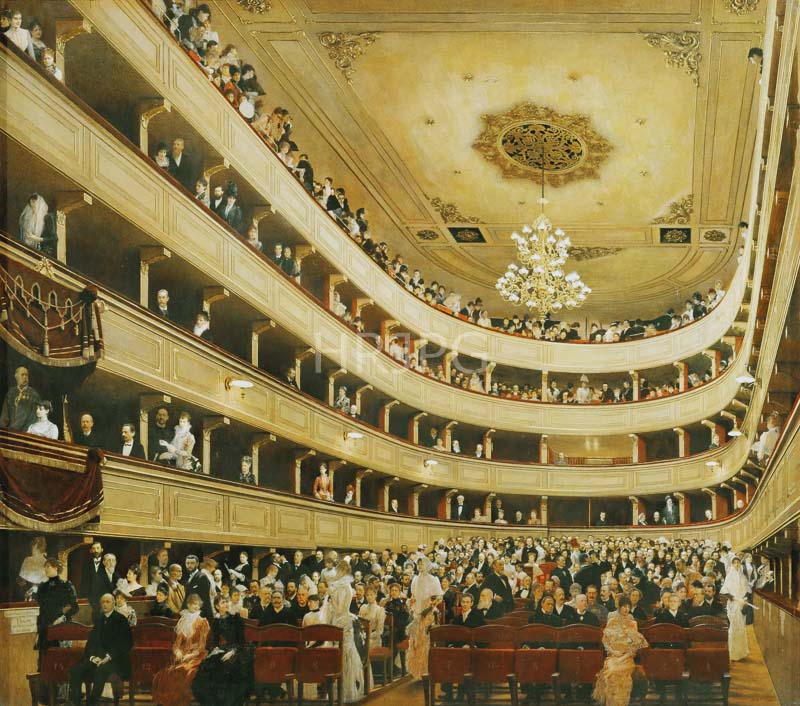
The extraordinary gouache painting "Auditorium of the Old Burgtheater" was created by Gustav Klimt between 1888 and 1889. This work represents the pinnacle of his "Early Academic Period" and earned him the prestigious Emperor’s Prize (Kaiserpreis), effectively launching his career as the leading artist of the Viennese establishment. Commissioned just before the original theater on the Michaelerplatz was demolished, the painting was intended as a historical record of the city’s social and cultural heart. It is a masterclass in "architectural realism" and remains one of the most technically accomplished group portraits in the history of Western art.
Technically, the work is a tour de force of "miniaturist precision" and complex group composition. Klimt painstakingly rendered over 150 individual, recognizable figures from the Viennese elite—politicians, actors, and socialites—each with distinct features and psychological presence. The composition utilizes a deep, perspectival view from the stage, capturing the magnificent interior of the theater with its gilded balconies and velvet curtains. The lighting is remarkably sophisticated, using the glow of the gas lamps to create a warm, atmospheric interior that highlights the social "spectacle" of the audience. Klimt utilizes a fine-grained gouache technique to capture textures ranging from the shimmer of silk gowns to the cold stone of the columns. Despite the sheer density of detail, the work remains harmoniously organized, with the eye led through the rhythmic repetition of the balconies toward the luminous central figures. This ability to maintain "clutter-free clarity" amidst hundreds of subjects was what earned him early academic acclaim and marked him as a virtuoso of historical painting.
Historically, the 1880s were a time of grand imperial projects in Vienna, and the Burgtheater was the spiritual home of the Austro-Hungarian Empire's upper class. The painting captures the "Ringstrasse era" at its absolute zenith, a society defined by order, luxury, and the glorification of tradition. However, the intensity of Klimt’s observation also hints at the "Fin-de-Siècle" obsession with looking and being seen—a theme that would later evolve into his more controversial Symbolist works. This commission was a major achievement for the young "Künstlercompagnie," establishing Klimt as the favored decorator of the empire's new public monuments.
Art criticism has long identified "Auditorium of the Old Burgtheater" as the ultimate "swan song" of Viennese academic realism. Critics such as Frank Whitford have noted the "obsessive, almost photographic" quality of the work, describing it as a masterpiece of social documentation. The painting is praised for its "technical stamina," proving that Klimt possessed the rigorous foundations necessary to eventually break and reinvent the rules of art. Today, it is regarded as a vital record of a vanished world, standing as a testament to the artist's ability to capture the "monumental pulse" of a city through the collective portrait of its people. It remains a cornerstone for understanding the origins of modern Viennese art.