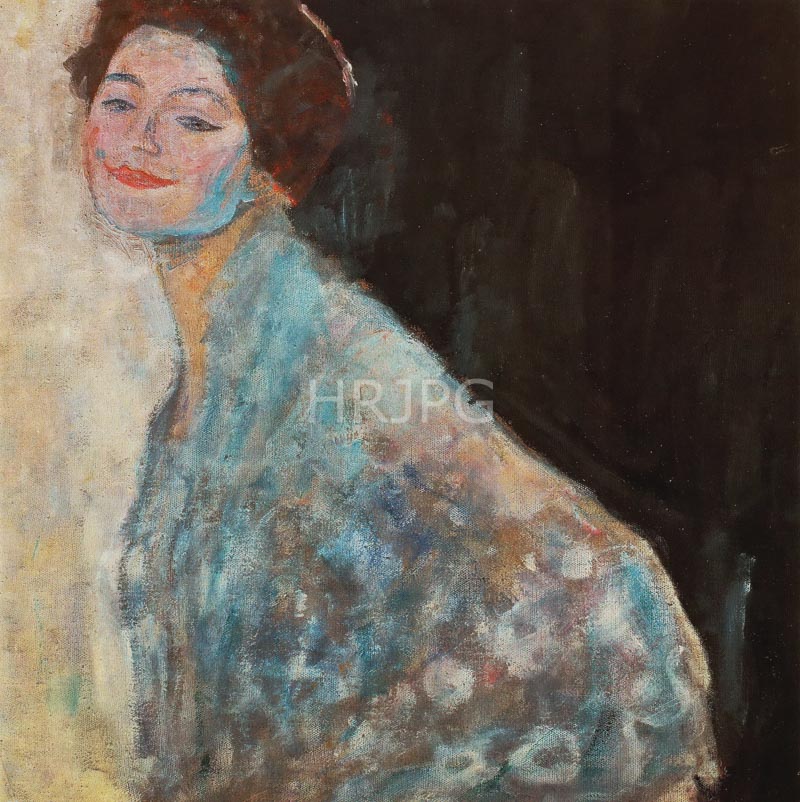
The "Portrait of a Lady in White" was executed by Gustav Klimt between 1917 and 1918, remaining unfinished in his studio at the time of his death. This poignant work offers an extraordinary, almost voyeuristic window into the creative mind of the master during his final months. Unlike the meticulously polished "Golden Phase" masterpieces, this canvas reveals the raw layers of Klimt's process—from the initial charcoal underdrawing to the first washes of oil. It is a rare example of a "non-finito" work that possesses a modern power precisely because it is incomplete, capturing a fleeting moment in the evolution of his International Style.
Technically, the painting is celebrated for its unusual emotional tone. While the women in Klimt's earlier portraits often appear as somber or ecstatic icons, this "Lady in White" smiles broadly, radiating a sense of genuine, unselfconscious joy that is nearly unique in his oeuvre. Klimt focuses his attention on her face, utilizing soft, luminous skin tones that contrast with the roughly sketched areas of her gown and the background. The composition is vertical and elegant, with the woman positioned centrally. The "unfinished" nature of the gown is particularly revealing; we can see how Klimt planned to integrate vibrant decorative patterns and floral motifs, using gestural strokes that suggest he was moving toward an even more expressive and painterly aesthetic. The lack of a completed background creates a dreamlike, ethereal space that pushes the subject's cheerful personality to the forefront.
Historically, the identity of the sitter remains a subject of debate among art historians, with some suggesting she may be a member of the Viennese upper-middle class or perhaps a close associate of the artist. The work was part of a group of unfinished canvases found in his studio following his stroke and subsequent death from pneumonia. This was a period of intense social collapse for Vienna, yet Klimt’s studio remained a sanctuary where he could continue to explore themes of beauty and vitality. The painting captures the spirit of a city on the brink of profound change, viewed through the lens of a man who was himself at the end of a legendary career.
Art criticism has long highlighted the "modernity" of this unfinished portrait. Critics such as Frank Whitford have noted that the visible sketching provides a "cinematic" quality, showing the artist’s hand in motion. The painting is praised for its "unvarnished sincerity," proving that Klimt’s brilliance was not dependent on gold leaf or complex allegories. Modern scholars often point to the subject's broad smile as a sign of Klimt’s own late-stage creative liberation. Today, it remains a vital reference for the study of his technique, standing as a beautiful and haunting reminder of a creative journey cut short. It is a masterpiece of potentiality, celebrating the human spirit through its luminous and joyful incomplete form.