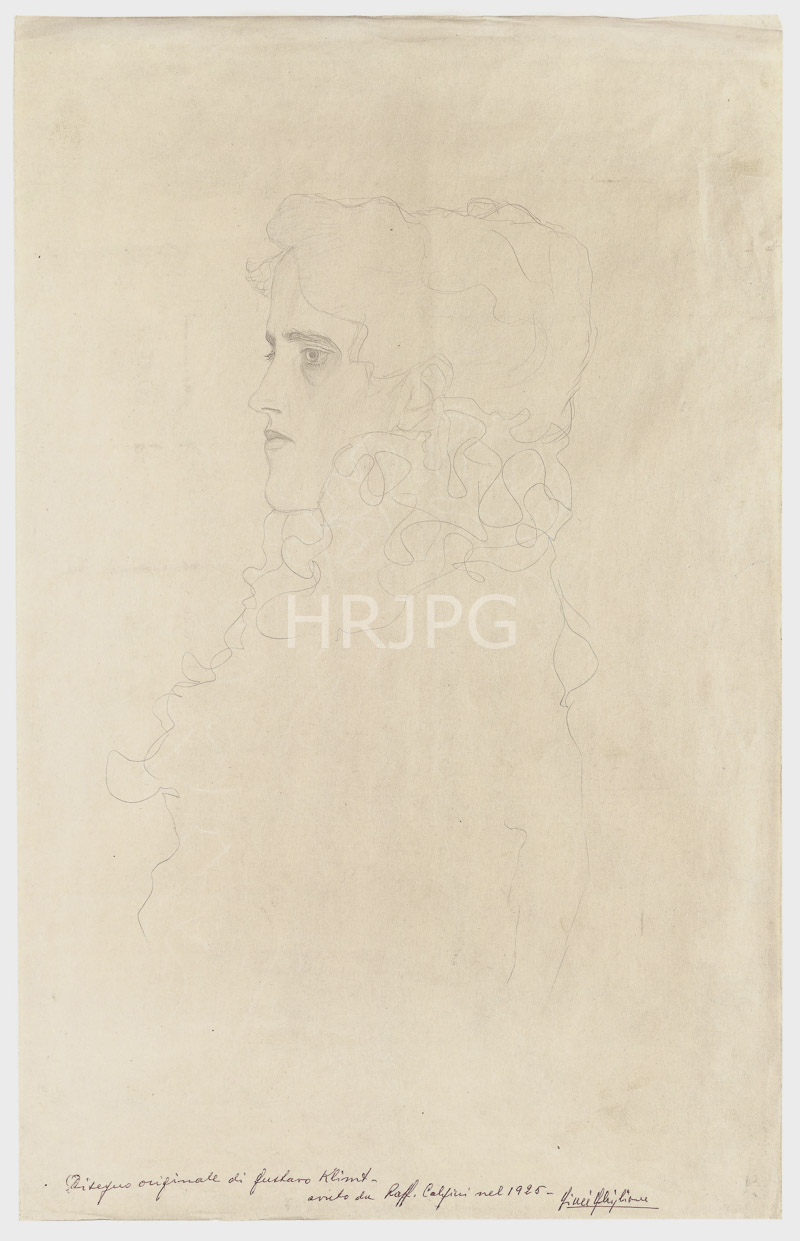
This elegant and sophisticated pencil drawing, "Portrait of a Woman in Profile," was executed by Gustav Klimt around 1900. It belongs to a critical turning point in his career, produced during the early years of the Vienna Secession when he was refining his "modern feminine portraiture." At the turn of the century, Klimt was already a favorite of the Viennese upper-middle-class elite, who sought to define their modern social status through his refined and psychologically resonant portraits. This work represents his search for a "linear aesthetic" that could convey both the "sophisticated aura" and the individual character of his subjects, reflecting the high-fashion sensibilities of turn-of-the-century Vienna.
Technically, the work is defined by its "delicate lines" and its focus on the architectural details of the subject's dress. Klimt depicts the woman in a sharp profile view, utilizing a remarkably fine pencil line to define her refined facial features—the sharp nose, the elegant chin, and the focused gaze. This profile view creates a sense of "dignified distance" and psychological introspection. A key technical detail is the rendering of the "high ruffled collar" and the intricate patterns of the garment, which are captured with a mix of rhythmic lines and subtle shading. This focus on the "textures of the textiles" anticipates the dense ornamentation of his later "Golden Phase" portraits. Klimt uses the pencil to create a "visual vibration" within the collar, contrasting its complex, frilled form with the smooth, soft contours of the woman’s skin. The composition is vertical and balanced, utilizing the white negative space of the paper to enhance the sense of the subject's "internal focus." This approach illustrates his mastery of "linear portraiture," where the clothing is not merely a costume but an extension of the subject’s personality and social status, creating a unified and modern aesthetic experience.
Historically, 1900 was a year of intense intellectual and creative fermentation in Vienna. The "Modern Woman" was emerging as a powerful cultural figure, and Klimt’s portraits provided a visual language for this new identity. The work reflects the influence of the "Pre-Raphaelites" and the "Symbolists" on the Secessionist aesthetic, particularly their focus on the "spiritual and psychological" qualities of the sitter. This was a period when Klimt was increasingly moving away from public allegories to focus on the private world of his wealthy patrons, allowing him to experiment with the formal properties of line and fashion in a controlled, domestic setting.
Art historians have consistently praised these early portrait studies for their "technical purity" and "refined sensitivity." Critics have noted that Klimt’s drawings from this period show his transition from an "academic virtuoso" to a "master of modern characterization." The drawing is praised for its "sophisticated elegance," proving that Klimt could achieve a sense of monumental beauty through the most minimal graphic means. Today, it is regarded as a vital document for understanding the anatomical and decorative foundations of his later career, standing as a testament to his unrivaled ability to capture the "aura" of a person through the elegance of a single line. It remains a moving and beautiful example of his search for the Gesamtkunstwerk within the human figure.