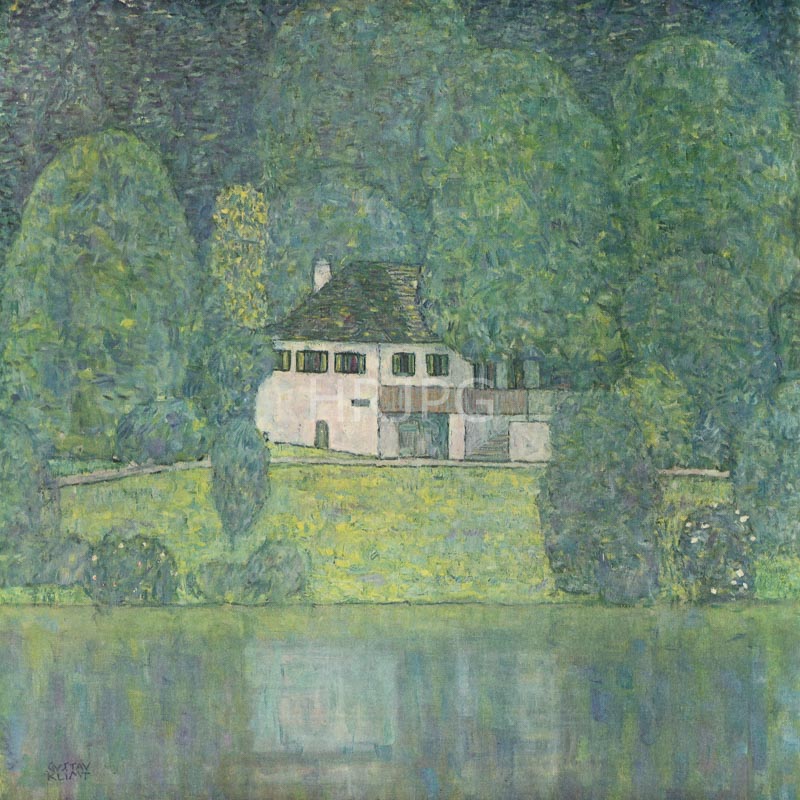
The lush and vibrant landscape painting "Litzlberg am Attersee" was created by Gustav Klimt between 1915 and 1916. This work belongs to his final mature period, often referred to as his "International Style," and was produced during his summer retreats to Lake Attersee. By this stage in his life, Klimt had moved away from the gold-leaf ornamentation of his middle years to focus on a more "painterly and expressive" representation of nature. Amidst the gathering shadows and social collapse of World War I, Klimt retreated into the "tranquil rhythms" of the Austrian countryside, and this painting serves as a profound celebration of that rural beauty and the enduring abundance of summer color.
Technically, the composition is a masterclass in "mosaic-like rhythmic brushstrokes" and the use of the square format. Klimt depicts the Litzlbergkeller and the surrounding foliage using a compressed perspective that brings the architectural and natural elements into a single, shimmering plane. He utilizes a palette dominated by varied, deep greens, ochre, and warm terracottas, applied with short, rhythmic dabs of paint that create a "vibrating surface texture." This approach captures the "play of light" across the hillside without relying on traditional chiaroscuro. The "architectural shapes" of the buildings are integrated into a dense pattern of greenery, effectively transforming the topographic scene into a "flattened decorative surface" that emphasizes rhythm over depth. This "all-over" composition forces the eye to wander through the textured richness of the paint, mirroring the "immersive qualities" of the natural world. The high horizon line—a characteristic influenced by Japanese prints—forces the viewer to stay focused on the "mosaic of leaves" and roofs, creating a sense of eternal, static beauty that was the hallmark of his late landscape style.
Historically, 1915 and 1916 were years of profound personal and political transition for Klimt. The landscapes produced during these summers were his most private works, created for his own satisfaction rather than for public commissions. The focus on the Litzlberg region, which he often viewed through a telescope from across the water, allowed him to achieve a unique, "telescopic" flattening of space. This period saw Klimt influenced by the works of Van Gogh and the French Fauves, leading to a more subjective and emotionally charged use of color. The work exemplifies the Secessionist ideal of the Gesamtkunstwerk, where even a simple rustic cellar is treated as a component of a total, modern work of art.
Art historians have long celebrated "Litzlberg am Attersee" for its "extraordinary atmospheric intensity." Critics such as Frank Whitford have noted that Klimt’s late landscapes are "purely optical experiences," where the landscape becomes a vehicle for pure color and pattern. The painting is praised for its "modernity," prefiguring the later developments of total abstraction. Today, it remains one of the most sought-after and beloved works in his landscape repertoire, standing as a testament to Klimt's unrivaled ability to transform a simple natural observation into a profound and shimmering tapestry of life. It is regarded as a masterpiece of European Symbolism, capturing a sense of nature as a sacred and decorative space.