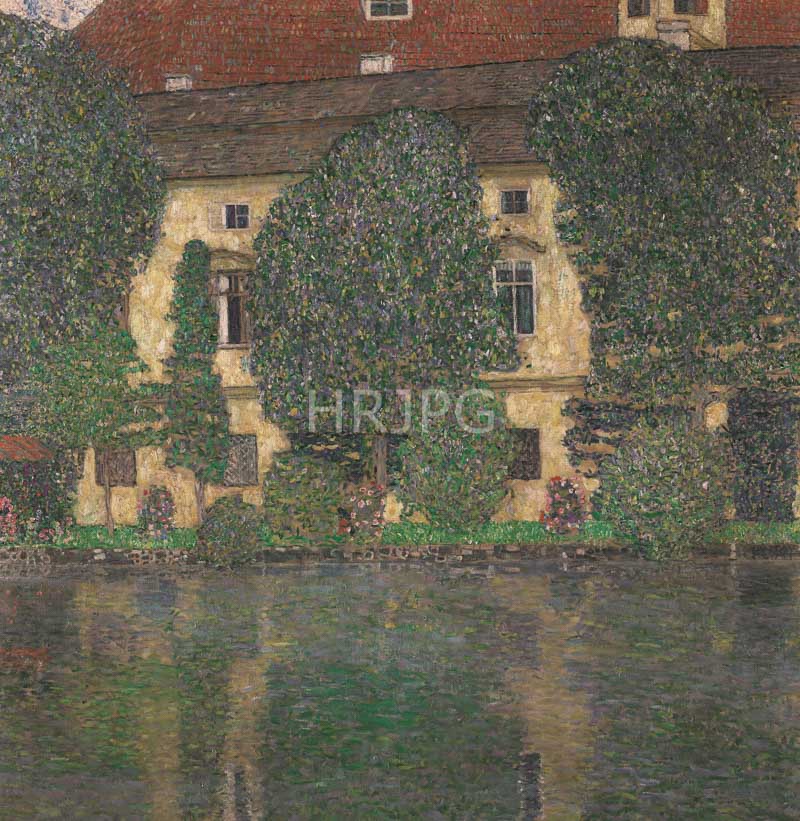
The enchanting oil painting "The Schloss Kammer on the Attersee" (also known as Schloss Kammer am Attersee III) was created by Gustav Klimt in 1908. This work belongs to his highly acclaimed series of Attersee landscapes, produced during his annual summer residences at the lake. Created at the very height of his "Golden Phase," this painting represents a unique synthesis of Art Nouveau decoration and Symbolist depth. In this work, Klimt turns his attention to the historic architecture of the region, treating the stone structure of the castle with the same jewel-like intensity as he did the surrounding foliage and the shimmering water of the lake, reflecting his search for "total harmony" within the natural world.
Technically, the composition is a masterpiece of "flattened decorative surface" and compressed perspective. Klimt utilizes a high horizon line, which pushes the castle and the distant hills to the very top edge of the canvas, effectively forcing the viewer's eye to focus on the "mosaic of patterns" created by the greenery and the water reflections. The architecture of the castle is integrated into a dense arrangement of brushstrokes, where the distinctions between natural and man-made forms begin to dissolve. Klimt utilizes a vibrant color palette of emerald greens, turquoise, and warm earth tones, applied with short, rhythmic dabs that create a shimmering effect. The reflections in the water are not rendered realistically but are instead treated as an extension of the decorative pattern of the shore, echoing the aesthetics of Byzantine mosaics which he had seen in Ravenna. This approach prioritizes "pattern and texture" over traditional spatial perspective and atmospheric depth, transforming a topographic view of an Austrian landmark into a timeless, highly stylized work of art. The square format of the canvas enhances the sense of balance and order, creating an "immersive optical experience" for the viewer.
Historically, the "Schloss Kammer" series was a major part of Klimt's cultural project to celebrate the beauty of the Austrian landscape through a modern lens. These paintings were highly coveted by the Viennese elite, who saw in them a refined and aristocratic vision of their own summer retreats. This work demonstrates Klimt's search for the Gesamtkunstwerk even within the genre of landscape painting, where every element of the scene—from a single leaf to a stone wall—contributes to a unified aesthetic whole. It captures the spirit of "Fin-de-Siècle" Vienna, a culture that sought refuge in the permanence and beauty of nature from the rapid changes of the modern city.
Art criticism has long lauded "The Schloss Kammer on the Attersee" for its "extraordinary decorative intensity." Critics such as Frank Whitford have noted the "tapestry-like" quality of the work, describing it as a "landscape of light." The painting is praised for its "innovative design," where the architecture becomes a primary carrier of color and rhythm. Modern scholars often point to this work as a bridge between Symbolism and the move toward total abstraction. Today, it remains a cornerstone of major collections, standing as a testament to Klimt's unrivaled ability to transform the world into a shimmering, eternal mosaic of summer beauty. It is regarded as one of the finest examples of early 20th-century landscape art.