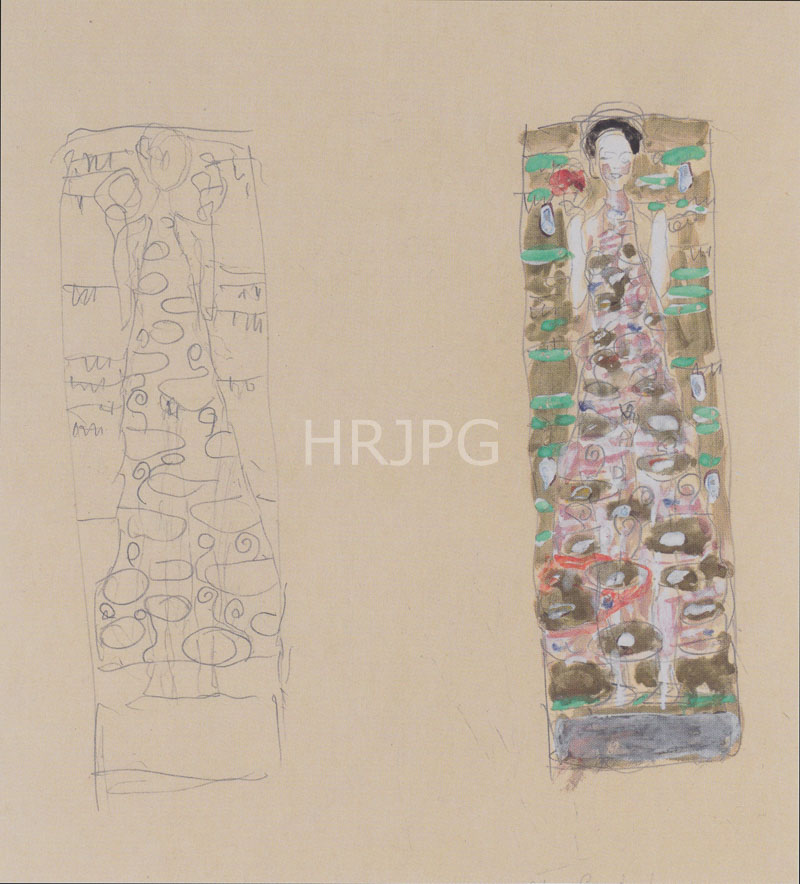
The two decorative designs titled "Zwei Entwürfe zum Schmuckblatt für Otto Wagner" were created by Gustav Klimt in 1911. These works were commissioned as part of a commemorative page to honor the 70th birthday of the legendary architect Otto Wagner, a towering figure in Viennese modernism and a close ally of the Secession. This project represents a rare and significant "synthesis of art and architecture," illustrating the deep creative bonds between the leaders of the Viennese avant-garde. Produced during Klimt’s mature period, these designs showcase his ability to adapt his figurative style to the rigid demands of graphic design and architectural ornament, reflecting the peak of the Secessionist aesthetic.
Technically, the composition is characterized by its "daring verticality" and the masterful blend of figurative and geometric elements. Klimt utilizes a mix of pencils and possibly colored accents to create two distinct layouts. One design focuses on an elongated female figure—a personification of architecture or art—surrounded by a dense mosaic of geometric patterns, circles, and squares. These motifs echo the architectural language of Wagner’s "Wagnerschule," characterized by structural clarity and modern materials. The second design is more abstract, emphasizing the "rhythmic organization" of decorative symbols that frame the commemorative text. Klimt’s line work is remarkably precise, illustrating his ability to find a "balance between organic flow and architectural order." The use of negative space is strategic, creating a sense of monumental dignity that was appropriate for honoring a man of Wagner’s stature. The "flattened decorative surface" reflects the influence of Japanese prints and Byzantine mosaics, transforming a graphic layout into a shimmering, modern work of art that feels both timeless and futuristic.
Historically, 1911 was a year of international consolidation for the Viennese modernists. The relationship between Klimt, Wagner, and the architect Josef Hoffmann was the emotional and intellectual anchor of the Wiener Werkstätte. This commemorative page was a public declaration of the "modern mission" of these artists to create a Gesamtkunstwerk (total work of art) that unified all branches of design. The work captures the spirit of "Modern Vienna"—a city that sought to define its identity through the radical integration of beauty and function, tradition and innovation. It serves as a visual manifesto for the "architectural soul" of the Secessionist movement.
Art historians and critics have praised these designs for their "graphic brilliance" and their innovative approach to commemorative art. Critics such as Frank Whitford have noted the "geometric purity" of the work, describing it as a "symphony of design." The designs are praised for their "sophisticated elegance," proving that Klimt’s brilliance extended far beyond the easel to the broader world of modern design. Today, these drafts are regarded as vital documents for understanding the collaborative nature of the Viennese avant-garde. They stand as a testament to Klimt's unrivaled ability to transform a functional graphic assignment into a profound and beautiful meditation on the power of modern architecture and the enduring legacy of Otto Wagner.