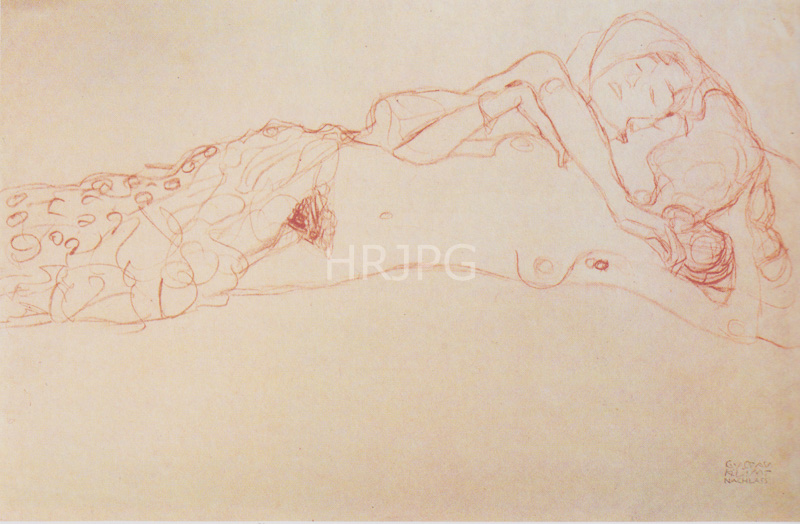
The evocative colored pencil drawing "Reclining Woman" was executed by the Austrian master Gustav Klimt around 1912 to 1913. This work belongs to his late mature period, a stage in his career where he retreated from the monumental, gold-encrusted allegories of his middle years to focus on the raw, intrinsic beauty of the human form within his private studio practice. These drawings were essential to his daily routine, serving as a laboratory for the anatomical simplifications and psychological investigations that would inform his late oil paintings. This specific piece represents his search for a "modern graphic language" that could convey the truth of the body through a combination of traditional skill and avant-garde intuition.
Technically, the work is defined by its "back view" and the use of colored pencil to create a warm, atmospheric tone. Klimt utilizes a series of fluid and rhythmic lines to trace the contours of the reclining female figure, emphasizing the weight and relaxation of the body. The choice of the back view is strategic; it shifts the focus from the subject's identity to the "geometry of form," turning the body into a landscape of curves and shadows. The lines are remarkably confident, varying in pressure to suggest volume and the soft texture of skin without the need for heavy hatching. The subtle addition of colored pencil provides a sense of "fleshiness" and warmth, contrasting with the negative space of the paper. This "linear economy" illustrates his mastery of the "Secessionist line," where a minimum of graphic means is used to convey a monumental physical presence. The pose is intimate and unposed, capturing a private moment that feels both authentic and highly stylized.
Historically, this work reflects the intellectual climate of "Fin-de-Siècle" Vienna, which was deeply influenced by the burgeoning field of psychoanalysis and the philosophical writings of Arthur Schnitzler. Klimt’s interest in the "unobserved nude" was part of a broader cultural movement toward the liberation of the body from Victorian social and artistic restrictions. This period saw Klimt moving away from the "decorative armor" of his earlier work toward a more "human-centered" and expressive style, influenced by his interaction with the younger generation of Expressionist artists like Egon Schiele. These private drawings were rarely exhibited during his lifetime, serving as a personal sanctuary of artistic honesty and exploration.
Art criticism has long identified Klimt’s late figure studies as some of the most innovative graphic works of the early 20th century. Critics such as Jane Kallir have noted that these works show Klimt at his most "sincere," revealing a deep empathy for his models. "Reclining Woman" is praised for its "melodic quality" and its ability to convey a sense of "anatomical grace" through the most minimal means. Today, it is regarded as a masterpiece of modern draftsmanship, proving that Klimt's genius was not dependent on gold leaf, but was rooted in his ability to see the extraordinary beauty in the simplest human form. It remains a vital reference point for understanding the development of the female subject in modern art.