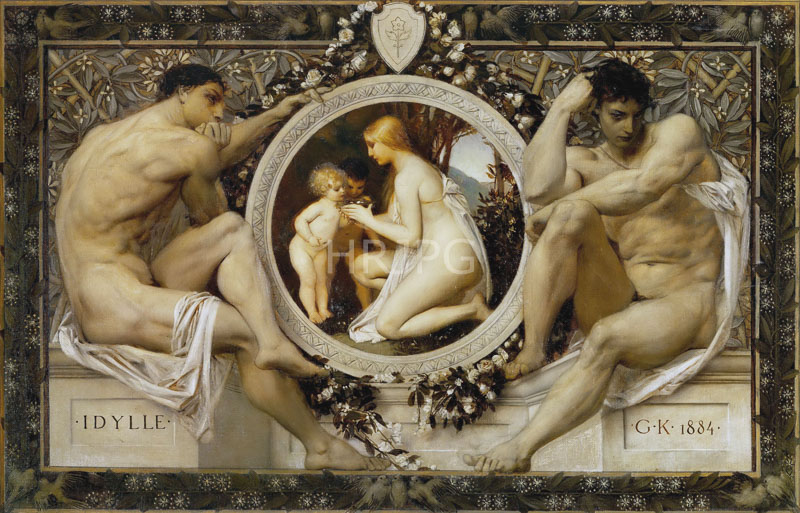
The monumental and early allegorical oil painting "Idylle" was created by Gustav Klimt in 1884. This work is a premier example of Klimt’s "Academic Period," produced while he was still a student at the Vienna School of Arts and Crafts (Kunstgewerbeschule). During these early years, Klimt, along with his brother Ernst and their friend Franz Matsch, formed the "Künstlercompagnie," specializing in large-scale historical and allegorical decorations for public buildings like the Burgtheater and the Kunsthistorisches Museum. "Idylle" represents the peak of his formal training, showcasing his extraordinary skill in "classical figure painting" and traditional compositional balance under the influence of the Great Master of the era, Hans Makart.
Technically, the composition is characterized by its "neoclassical symmetry" and its focus on the "muscular male nude." The central scene is a circular tondo depicting a woman with children in a lush, natural setting, symbolizing the "idyll" of maternal peace and domestic harmony. This central scene is flanked by two powerfully rendered, larger-than-life muscular men who lean against the architectural frame. These figures are rendered with "photographic realism" and precise anatomical modeling, reflecting Klimt’s mastery of the classical tradition. The color palette is rich and somber, dominated by earthy ochres, deep greens, and warm skin tones, characteristic of the "Makart style." A key technical detail is the "trompe l'oeil" effect of the architectural frame, which creates a sense of three-dimensional depth and grandeur. The background features stylized floral motifs that provide an early hint of the "decorative patterns" that would later define his Art Nouveau style. This work illustrates his ability to organize complex figurative elements into a "unified and balanced" whole, where the human body is treated with the same reverence as the architectural environment.
Historically, 1884 was a year of significant early success for the young Klimt. The "Künstlercompagnie" was receiving major commissions that defined the visual language of the Ringstrasse era. "Idylle" reflects the cultural values of the Austro-Hungarian Empire at its height—a society that valued order, tradition, and the glorification of classical ideals. This period saw Klimt as the "golden boy" of the academic establishment, long before he became the radical rebel who would found the Secession. The painting captures the spirit of "Historicism," where the past was used to provide a sense of stability and nobility to the modern world.
Art historians have consistently praised "Idylle" for its "prodigious technical mastery." Critics have noted that even at this early stage, Klimt’s work possessed a "decorative intensity" that set him apart from his peers. The painting is celebrated today as a crucial record of his "foundational genius," proving that his later stylized aesthetic was a deliberate evolution from a profound understanding of classical technique. Modern scholars highlight the work as a bridge between the 19th-century academic tradition and the 20th-century move toward modernism. It remains a cornerstone of the Belvedere collection, standing as a testament to the artist's ability to create works of monumental power and classical beauty. It is a vital document for understanding the origins of one of the most influential artists of the modern era.