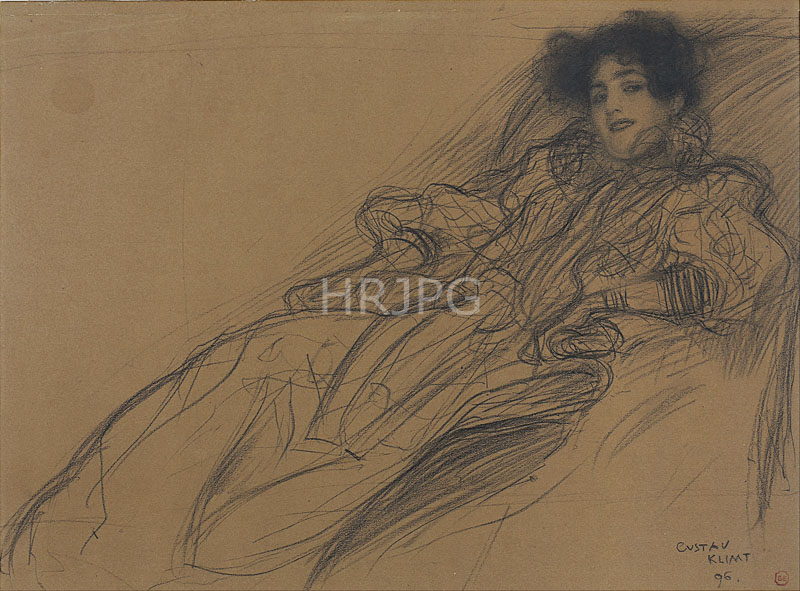
The evocative charcoal and crayon sketch "Young Woman in an Armchair" was produced by Gustav Klimt in 1896, a pivotal year just before the founding of the Vienna Secession. This work belongs to a critical transitional period in Klimt’s career, where he began to move away from the rigid academicism of his early murals toward a more "sketchy yet expressive" style that prioritized mood and psychological depth. At this stage, Klimt was already a renowned decorative painter, but it was through these private studies on brown paper that he developed the "modern feminine portraiture" that would soon revolutionize the Viennese art world. This work is a testament to his search for a more personal and intimate artistic voice.
Technically, the work is defined by its "painterly texture" and its focus on "sensual expression." Klimt utilizes a mix of charcoal and crayon to create a soft, atmospheric effect that captures the "volume of the body" and the rich textures of the garments. The woman is depicted in a reclining, languid pose, her head resting against the chair, conveying a sense of "unselfconscious relaxation." The lines are loose and gestural, a significant departure from the sharp, clear contours of his earlier historical murals. This "sketchy" technique allows the artist to focus on the "aura" of the subject rather than just her topographic details. The use of the "brown paper" as a mid-tone ground is a key technical detail; Klimt utilizes the natural color of the paper to suggest shadow and depth, adding highlights with crayon to create a sense of luminous skin and shifting light. The composition is intimate and compressed, inviting the viewer into a private salon environment. This approach emphasizes the "internal life" of the subject, suggesting a state of dreamlike introspection that was heavily influenced by the burgeoning Symbolist movement in Europe.
Historically, 1896 was a year of intense intellectual fermentation in Vienna, coinciding with the early writings of Sigmund Freud. The move toward a more "expressive portraiture" was a reaction against the materialism of the Ringstrasse era, as artists sought to represent the "hidden truths" of human existence. "Young Woman in an Armchair" reflects this broader cultural trend, where the "decorative" begins to merge with the "psychological." This period saw the birth of the "Klimt Group," as the artist gathered like-minded colleagues to discuss the future of modern art in Austria. These drawings were essential to his development, serving as a laboratory for the formal experiments that would lead to his mature masterpiece, "The Kiss."
Art historians have consistently praised this work for its "technical spontaneity" and "emotional honesty." Critics have noted that Klimt’s early drawings possess a "quiet monumentality" that anticipates the existential weight of 20th-century art. Contemporary reviews praised his ability to capture "modern character" through the simplest means. Today, it remains a vital document for understanding the anatomical and psychological foundations of his later career, standing as a testament to Klimt's ability to see the extraordinary grace within a quiet, domestic moment. It is regarded as a masterpiece of late 19th-century draftsmanship, proving that his genius was rooted in a deep understanding of human sensitivity.