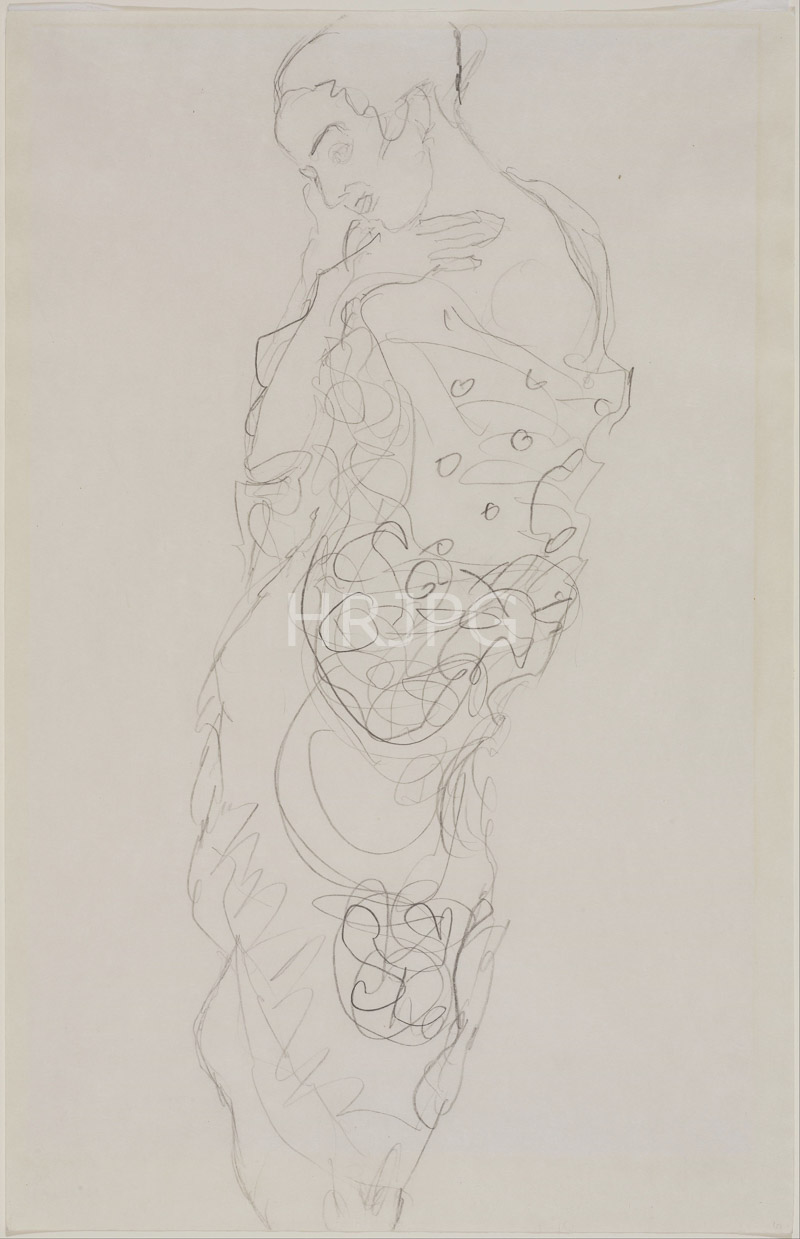
This exquisite and sensual pencil drawing, "Woman in Kimono left shoulder bare," was executed by Gustav Klimt between 1917 and 1918, during the very final months of his life. As one of his late graphic works, it encapsulates his lifelong fascination with "Japonisme" and the intimate allure of the female form. Throughout his career, Klimt was an avid collector of Japanese art and textiles, and the kimono became a recurring motif in both his public portraits and his private figure studies. This work represents a sophisticated "synthesis of architectural cloth and organic form," reflecting the artist's move toward a more expressive and modern graphic language before his untimely death in 1918.
Technically, the work is characterized by the masterful contrast between the "structured textiles" and the "soft contours of the body." Klimt utilizes a delicate yet remarkably confident pencil line to define the woman's face and her exposed left shoulder, capturing the "luminous skin" with a minimum of shading. The kimono itself is rendered as a complex field of "decorated patterns," where the rhythmic lines of the fabric create an architectural frame for the subject's vulnerability. This juxtaposition is a key technical detail; the "static" patterns of the garment emphasize the "dynamic" and soft reality of the flesh. The composition is vertical and focused, utilizing the white negative space of the paper to enhance the sense of "intimate sensuality." Klimt’s mastery lies in his "linear economy," where he suggests volume and weight through the varying thickness and pressure of the lead. The model's expression is one of "quietude and introspection," caught in a private, domestic moment that is characteristic of his late mature drawings. The way the lines of the hair and the kimono seem to flow into one another suggests a sense of "total harmony" between the person and her environment.
Historically, 1917 and 1918 were years of profound tragedy and change, marked by the collapse of the Austro-Hungarian Empire. This drawing reflects the "somber, reflective mood" of that era, as Klimt retreated into the private world of his studio to find solace in the study of beauty. The focus on Japanese fashion was not merely decorative but was part of the Secessionist effort to find a "universal aesthetic" that transcended national boundaries. This period saw Klimt moving away from the "decorative armor" of his gold paintings toward a more "human-centered" and expressive style, influenced by his interaction with the younger generation of artists.
Art historians and critics have frequently praised these late drawings for their "psychological resonance" and "modernity." Critics such as Christian Nebehay have argued that Klimt's late studies show him at his most "honest," revealing a deep empathy for his models. The drawing is praised for its "minimalist beauty," proving that Klimt could achieve a sense of monumental presence through the most simple graphic means. Today, "Woman in Kimono left shoulder bare" is regarded as a masterpiece of modern draftsmanship, standing as a poignant testament to Klimt's unrivaled ability to capture the "aura" of a person through the elegance of a single line. It remains a vital reference point for understanding the evolution of the female subject in early 20th-century art.