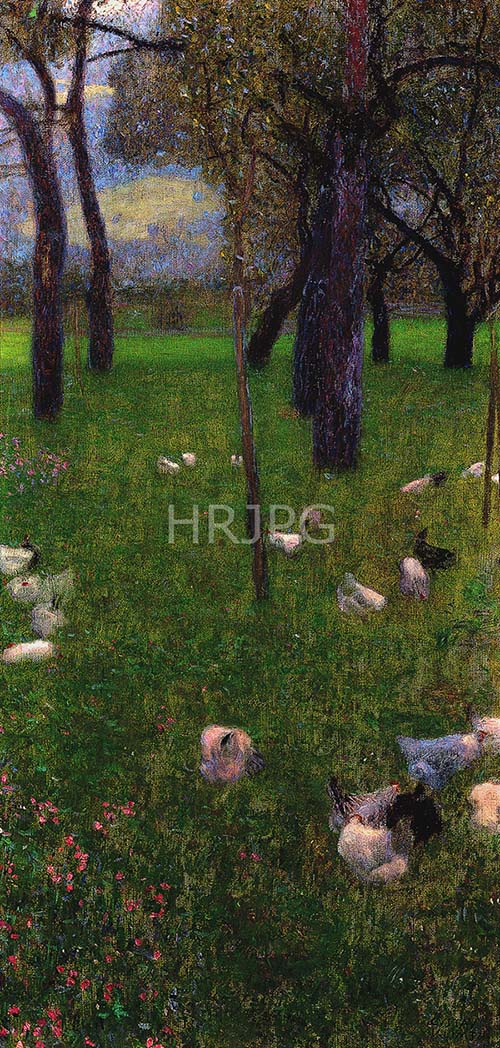
The enchanting oil landscape "After the Rain" (also known as "Garden with Chickens in St. Agatha") was painted by Gustav Klimt in 1899. This work belongs to his early landscape period, a time when he was just beginning to establish his annual summer tradition of painting in the Austrian countryside. In 1899, Klimt was a leading figure of the newly formed Vienna Secession and was actively seeking a "new path" for landscape art that would move away from traditional topography toward a more personal and Symbolist vision of nature. This painting captures the "atmospheric freshness" of a rural garden after a rainstorm, representing a pivotal moment in his stylistic evolution.
Technically, the work is defined by its "high horizon line" and its vibrant, saturated application of color. Klimt fills the majority of the canvas with a lush, green meadow, pushing the sky and the distant buildings to the very top edge. This compositional choice—influenced by Japanese Ukiyo-e prints—creates a "flattened decorative space" that forces the viewer to focus on the surface textures and patterns of the grass and flowers. He utilizes small, rhythmic brushstrokes to capture the shimmering, damp quality of the light, creating a sense of "jewel-like intensity" that would later become a hallmark of his mature style. The "chickens" of the title are rendered as small dabs of color, adding a touch of rustic realism that grounds the highly stylized scene. The use of varied greens, punctuated by the bright colors of the flowers, creates a visual vibration that suggests the "vibrancy of life" immediately following a storm. This approach prioritizes "mood and texture" over traditional three-dimensional perspective, transforming a simple garden into a shimmering, decorative paradise.
Historically, 1899 was a year of profound creative fermentation for Klimt. His summer retreats to St. Agatha provided a necessary mental escape from the intense public controversies surrounding his "Faculty Paintings" in Vienna. This work reflects the influence of international movements, particularly the "Stimmungsimpressionismus" (Mood Impressionism) popular in Central Europe, combined with the rising interest in Symbolism. The painting serves as a bridge between the naturalistic observation of his youth and the intricate "mosaic style" of his later "Golden Phase," reflecting the Secessionist search for a "total work of art" even within the simplest natural scenes.
Art historians have long marveled at the "modernity" of "After the Rain." Critics such as Frank Whitford have noted the "obsessive observation" and the "ornamental harmony" of the work, describing it as a landscape that has been "filtered through a poetic lens." The painting is praised for its ability to capture a fleeting atmospheric moment and transform it into a timeless aesthetic experience. Modern scholars highlight the work as a crucial document of Klimt’s early landscape style, proving that his brilliance was rooted in his ability to see the sacred and decorative within the mundane. It remains a cornerstone for understanding his enduring fascination with the rhythms of the natural world and his role as a pioneer of modern landscape painting.