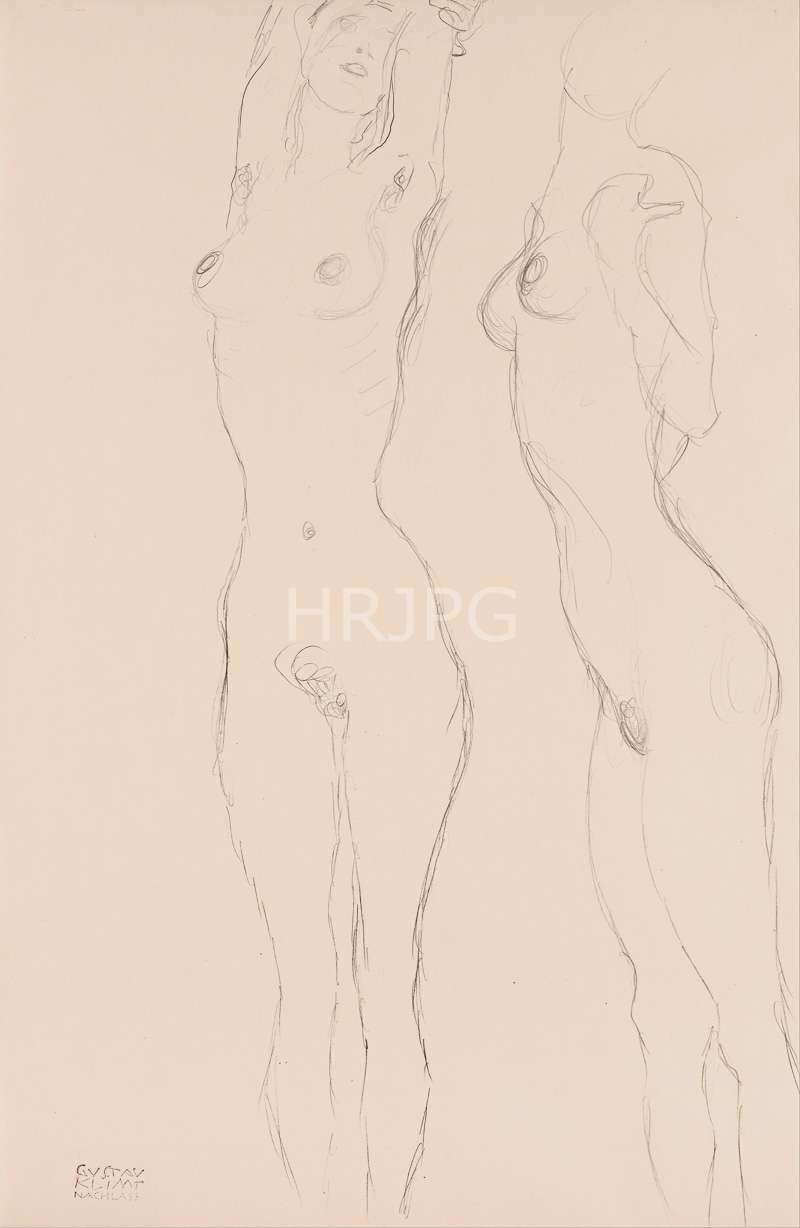
This masterful graphite drawing, titled "Two Nudes the Left One with Raised Arms," was executed by the Austrian visionary Gustav Klimt between 1911 and 1912. Produced during his late mature period, this work serves as a quintessential example of his private figure studies, which he created daily in his studio. During these years, Klimt moved away from the rigid, gold-encrusted allegories of his famous "Golden Phase" to explore a more fluid and psychologically unvarnished representation of the human form. These drawings were central to his artistic process, acting as a laboratory for the anatomical simplifications that would later define his late oil paintings, reflecting the shifting aesthetic landscape of Vienna on the eve of the Great War.
Technically, the composition is a study in "relaxed verticality" and linear rhythm. Klimt depicts two standing female nudes, with the figure on the left raising her arms in a gesture that creates a dynamic vertical axis. He utilizes a singular, continuous contour line to define the silhouettes, varying the pressure of the graphite to suggest the soft volume of flesh and the structural grace of the spine. The "raised arms" are a key technical detail, as they create a sense of rhythmic motion and spatial depth that activates the surrounding negative space of the paper. There is almost no traditional cross-hatching or heavy shading; instead, the artist relies on the "vibration" of the line itself to suggest presence and light. This approach highlights Klimt's mastery of "linear economy," where a minimum of graphic means is used to convey a monumental physical and psychological presence. The white space of the paper acts as an ethereal environment, emphasizing the figures' state of quietude and self-assured intimacy.
Historically, this work reflects the influence of the younger Viennese Expressionists, such as Egon Schiele and Oskar Kokoschka, who encouraged Klimt to embrace a more nervous and emotionally honest quality in his draftsmanship. This was a period of intense cultural transition, where the decorative grace of Art Nouveau was evolving into a more existential exploration of the human condition. Klimt’s studio remained a sanctuary where he could observe his models in unposed, natural states, challenging the moral taboos of the era through a sincere investigation of "erotic truth" and the mysteries of the human form.
Art historians and critics have frequently praised Klimt’s late drawings for their "extraordinary graphic refinement." Critics such as Jane Kallir have noted that these works show Klimt at his most "authentic," revealing a deep empathy for his subjects. The drawing is celebrated for its "melodic quality," where the line itself becomes a form of artistic breath. It remains a vital reference point for understanding the development of modern figurative art, demonstrating how Klimt transformed the traditional academic nude into a vehicle for modern psychological expression. Today, it is regarded as a masterclass in modern draftsmanship, proving that his brilliance was rooted as much in linear elegance as in decorative splendor.