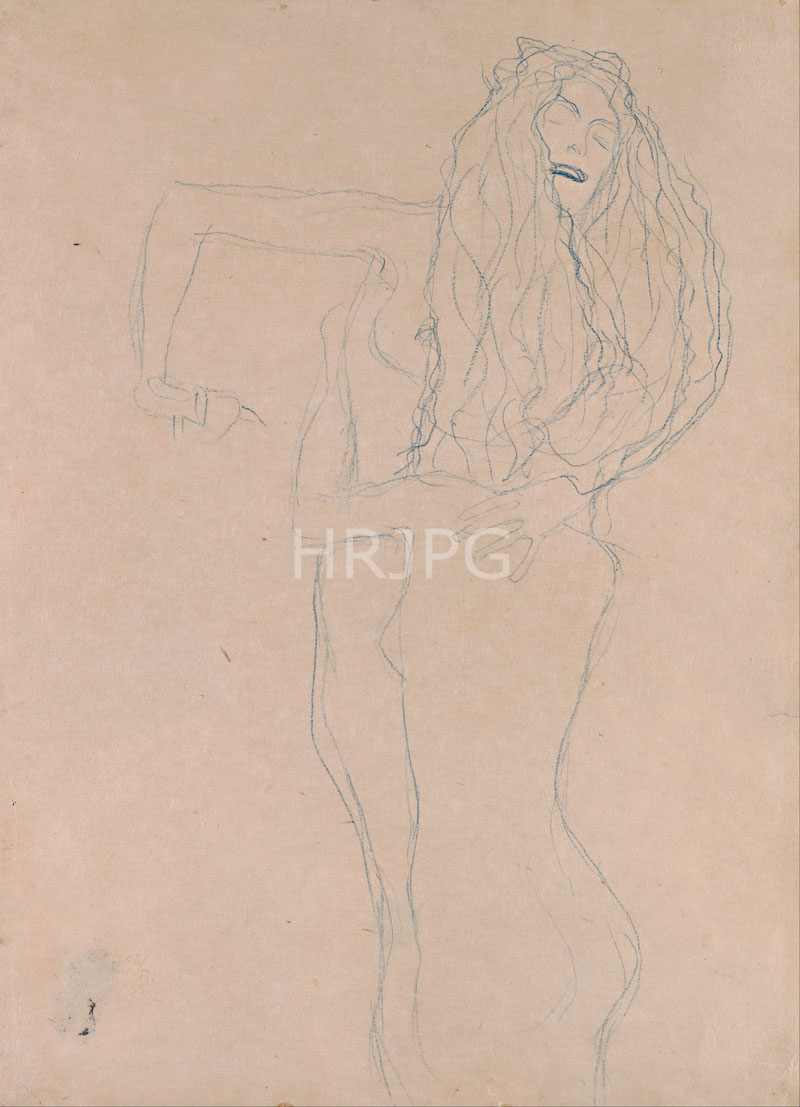
This delicate and evocative pencil drawing, "Two Naked Women Embracing," was created by Gustav Klimt in 1903. It was produced specifically for the publication Ver Sacrum ("Sacred Spring"), the official journal of the Vienna Secession, which sought to integrate graphic arts, typography, and literature into a unified modern aesthetic. This period in Klimt's career was defined by his radical exploration of eroticism and the "liberation of the body," as he challenged the moral taboos of the Austro-Hungarian establishment. The drawing serves as a masterclass in the "Secessionist line," where anatomical truth is synthesized with a sophisticated, decorative graphic style to explore themes of intimacy and emotional connection.
Technically, the work is defined by its "rhythmic, continuous contours" and its focus on anatomical simplification. Klimt depicts two nude women in a tight embrace, utilizing long, sweeping strokes of the pencil to define the fluid forms of their bodies. There is a remarkable sense of "organic unity" in the composition; the limbs and silhouettes of the two figures merge into a single, complex pattern across the page. The line work is both delicate and firm, varying in pressure to suggest volume and the soft texture of skin without the need for traditional shading or cross-hatching. This "linear economy" allows the white space of the paper to act as a luminous, ethereal environment, emphasizing the "psychological intimacy" of the moment. The influence of "Japonisme" is evident in the compressed perspective and the way the figures are cropped, creating a sense of voyeuristic proximity. Klimt’s mastery lies in his ability to convey "monumental beauty" through the most minimal graphic means, using the line itself as a vehicle for "physical joy" and "emotional depth."
Historically, the year 1903 marked the peak of the Secession’s cultural influence in Vienna. The publication of such drawings in Ver Sacrum was a revolutionary act, intended to bring high-quality graphic art to a wider public and to champion "artistic freedom" over academic censorship. Klimt’s erotic drawings were part of a broader "sexual revolution" in Viennese intellectual life, paralleling the early discoveries of Sigmund Freud. These works reflect the "Fin-de-Siècle" move toward a more subjective and honest representation of human desire, where the "erotic" was viewed as a sacred and essential part of the human experience.
Art historians and critics have frequently praised "Two Naked Women Embracing" for its "extraordinary graphic refinement." Critics like Jane Kallir have noted that Klimt’s drawings for Ver Sacrum show his transition from a "painter of allegories" to a "master of modern life." The drawing is celebrated for its "sophisticated simplicity," proving that Klimt could achieve a sense of "timeless grace" through the simplest tools. Today, it remains a vital document for understanding the development of modern graphic expression and the shift from 19th-century "realism" to the psychological and expressive honesty of the 20th century. It stands as a moving tribute to the power of human connection and the enduring beauty of the female form.