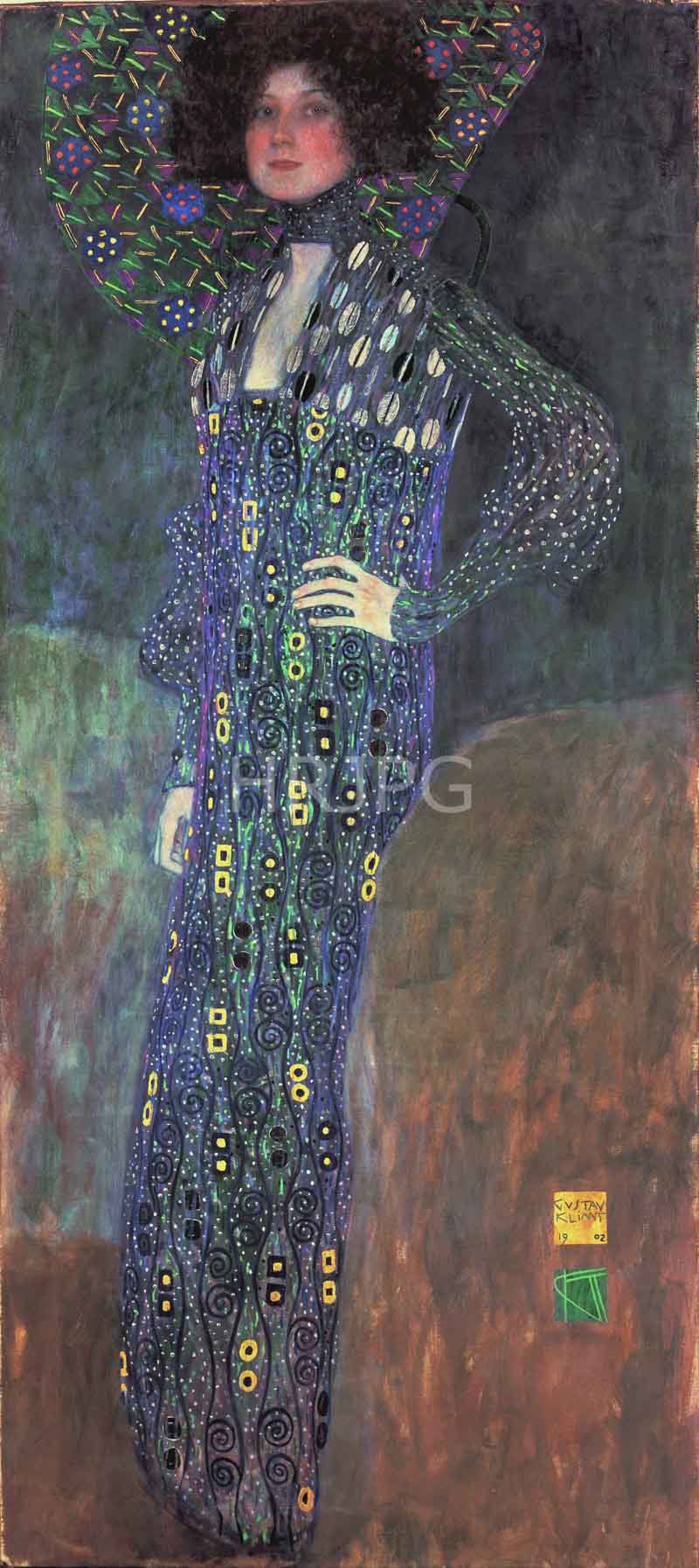
The monumental "Portrait of Emilie Flöge" was painted by Gustav Klimt in 1902, representing a landmark work of the Vienna Secession. Emilie Flöge was Klimt’s lifelong companion, a prominent fashion designer, and a leading figure in the "Reform Dress" movement in Austria. This portrait is a profound celebration of her intellect, elegance, and modern spirit. Unlike his earlier societal portraits, this work was a personal tribute, blending the "realistic modeling" of Emilie’s face with a dense mosaic of geometric patterns that reflect her own avant-garde approach to fashion and design. It serves as a visual manifesto for the "modern woman" of turn-of-the-century Vienna.
Technically, the composition is characterized by its "daring verticality" and the use of an extraordinary blue-toned palette. Emilie is depicted wearing a futuristic, full-length "reform gown" of her own design, which Klimt renders as a shimmering, vertical column of intricate patterns—spirals, circles, and gold accents. This "flattened decorative surface" was heavily influenced by the Byzantine mosaics of Ravenna and Japanese prints, which Klimt synthesized into a unique Art Nouveau language. The face and hands are rendered with soft, three-dimensional realism, creating a striking contrast with the abstract, jewel-like density of the dress and the mottled, decorative background. The use of blue and silver tones creates an "ethereal aura" that emphasizes Emilie’s sophisticated and slightly aloof personality. The composition is structured to present her as a "secular icon," her form elongated to suggest noble dignity. Klimt utilizes the "pattern" not just as decoration, but as an architectural framework that supports the subject, illustrating the Secessionist ideal of the Gesamtkunstwerk where the person and their aesthetic environment are inseparable.
Historically, 1902 was a year of intense creative output for the Secession, coinciding with the "Beethoven Exhibition." The relationship between Klimt and Flöge was the emotional anchor of his life, and this painting captures the "creative partnership" between the two artists. The "Reform Dress" movement sought to liberate women from the restrictive corsetry of the 19th century, a goal that mirrored Klimt’s own mission to liberate art from academic tradition. This portrait was initially rejected by Emilie’s family for being too "radical," illustrating the provocative nature of Klimt’s modern vision even among his closest circle.
Art criticism has long identified the "Portrait of Emilie Flöge" as one of the most successful syntheses of "fashion and fine art." Critics such as Frank Whitford have noted the "psychological depth" of her expression, describing it as a "portrait of modern independence." The painting is praised for its "innovative design," where the dress becomes a primary expressive element. Modern scholars highlight the work as a masterpiece of the "Jugendstil," noting its profound influence on the later developments of modern fashion illustration and decorative painting. Today, it is a centerpiece of the Wien Museum, standing as a testament to the enduring elegance and visionary spirit of the woman who was Klimt's constant source of inspiration and support.