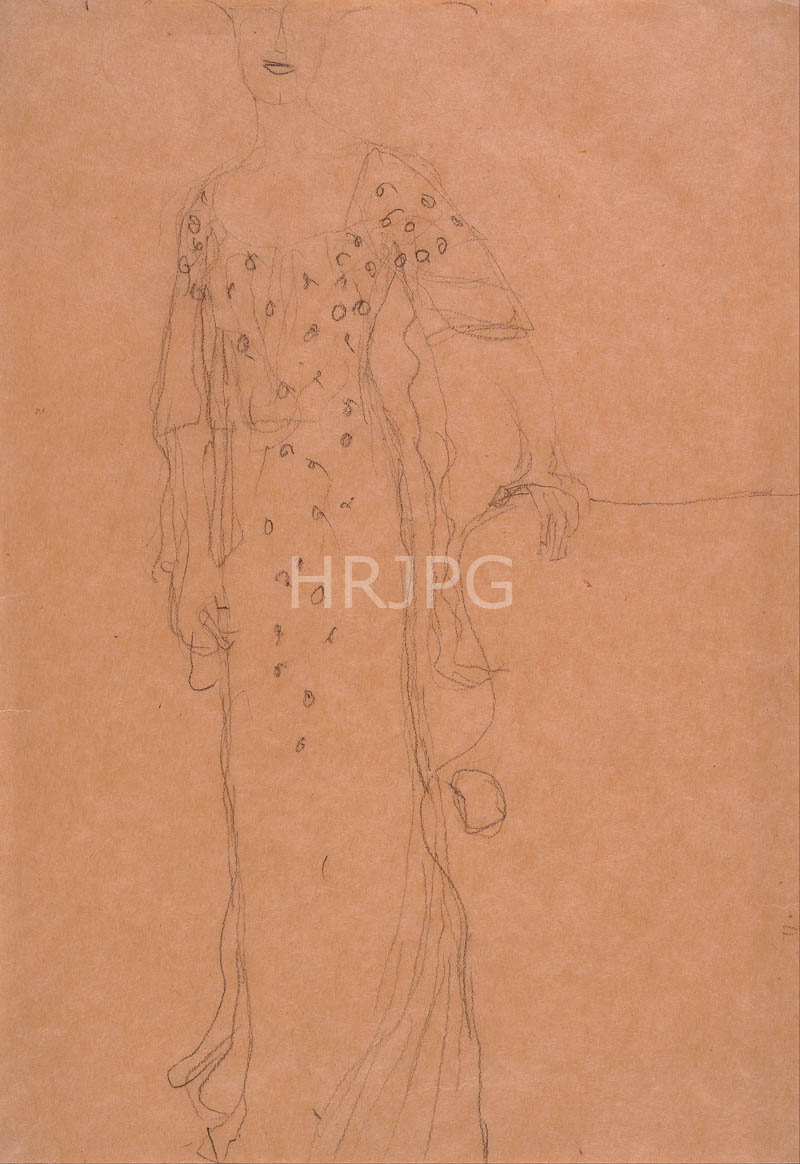
This meticulous and historically significant pencil study on reddish paper was executed by Gustav Klimt between 1903 and 1904. It serves as a vital preparatory design for his most famous masterpiece, the "Portrait of Adele Bloch-Bauer I" (often called "The Woman in Gold"). This study was produced at the very beginning of Klimt's "Golden Phase," a period following his travels to Ravenna, where he was deeply inspired by the Byzantine mosaics. The reddish paper provides a warm, atmospheric ground for his graphite lines, allowing him to explore the "synthesis of architectural form and ornamental detail" that would define the final iconic painting.
Technically, the study focuses on the "posture" and the complex placement of decorative motifs on Adele’s gown. Klimt utilizes a remarkably precise yet fluid line to define the seated figure’s refined features and her characteristic clasped hands—a gesture intended to hide a disfigured finger. The drawing shows the artist’s search for a "geometric order" within the textiles, as he maps out the placement of the "eye" motifs, triangles, and swirling patterns that would later be rendered in gold leaf. There is a sense of "monumental stillness" in the pose, which Klimt balances with the "nervous energy" of his decorative sketches. The use of negative space around the figure is strategic, emphasizing the "architectural" silhouette of the gown as it merges with the armchair. This study reveals Klimt's mastery of anatomical simplified form, where the soft realism of the face is anchored by a rigid, ornamental structure. By using the reddish paper, he suggests the "luminous skin tones" and the warmth of the future golden background, demonstrating his ability to envision a complete aesthetic experience even in a preliminary sketch.
Historically, the relationship between Klimt and Adele Bloch-Bauer was central to the Viennese avant-garde. Adele was a prominent intellectual and a member of the Jewish upper-middle-class elite who served as Klimt's most significant patron and muse. This commission was a major project for the Bloch-Bauer family, intended to represent their high social status and their commitment to modern art. The study reflects the intellectual fermentation of "Fin-de-Siècle" Vienna, where the surface of a portrait was treated as a mirror of the subject’s "inner psyche" and social world. The work captures the transition from Art Nouveau decoration to a more symbolic and structured modernism.
Art historians, including Frank Whitford and Jane Kallir, have identified these "Adele studies" as some of the most important graphic records in modern art history. Critics praise the "unvarnished honesty" of the sketches, which show the artist’s tireless search for perfection. The drawing is celebrated for its "sophisticated elegance," proving that the "Golden Phase" was built on a foundation of rigorous draftsmanship. Today, it remains a vital reference for understanding the complex layers of meaning and the meticulous labor that went into creating the "Mona Lisa of Austria." It stands as a testament to Klimt's genius in unifying the human spirit with the power of the ornament.